~By Rajan V Nair
Heavy machinery, mass formations and brute force once defined military power. Not anymore. Across conflict zones worldwide, the soldier on the ground is increasingly being supported and in some cases replaced by autonomous drones, electronic warfare systems and precision-strike platforms that can neutralise a target before an enemy even detects a presence. This technological revolution in warfare found a compelling showcase at PRAGATI 2026.

Held at the Field Training Node in Umroi, near Shillong, from May 18 to 31, PRAGATI, an acronym for Promoting Regional Cooperation and Training for ASEAN and Friendly Nations, marked the first edition of what is poised to become a landmark multilateral military exercise. Organised jointly by FICCI, the Indian Army’s Headquarters Eastern Command and the Army Design Bureau, the event drew military contingents and defence representatives from 12 nations, among them six ASEAN members: Cambodia, Indonesia, Laos, Malaysia, the Philippines and Vietnam. Bhutan, Maldives, Myanmar, Nepal, Seychelles and Sri Lanka rounded out the gathering.
But PRAGATI was more than a military exercise. The accompanying Industry Exposition turned Umroi into a window onto India’s quietly accelerating defence manufacturing revolution one where the private sector is no longer a peripheral player but an increasingly central force.
Adani Defence & Aerospace arrived with perhaps the most comprehensive display of indigenous battlefield technologies at the exposition. Spanning counter-drone systems, loitering munitions, electronic warfare capabilities, small arms, ammunition and missile platforms, the portfolio was a statement of intent: that Indian industry can now design, manufacture and deliver advanced defence technologies across multiple operational domains.
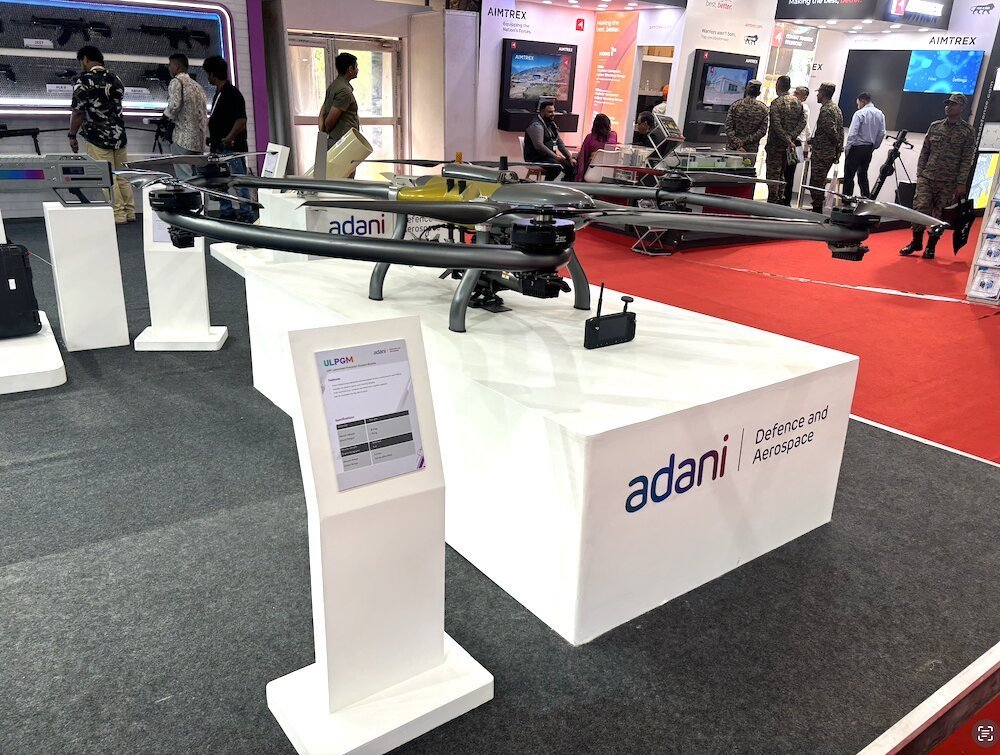
The systems that drew the most attention were those built for the new frontline, the electromagnetic spectrum. Counter-drone and electronic warfare capabilities have gone from niche to indispensable in modern conflict, and Adani’s layered counter-UAS architecture reflected that shift. Vehicle-mounted and SUV-mounted platforms designed to detect, track and neutralise hostile drones in diverse environments formed the backbone of the display. More striking still was the company’s “Cyber Takeover” capability a system engineered not merely to jam or destroy adversarial unmanned platforms, but to seize control of them entirely. In an era where drone swarms can overwhelm conventional air defences, the ability to turn an adversary’s own assets against them represents a significant tactical edge.
Alongside these systems, the company showcased its loitering munitions portfolio, weapons that can orbit a target area autonomously before striking with precision, increasingly seen as force multipliers in asymmetric and conventional warfare alike. Completing the picture were the recently delivered 7.62 mm Prahar Light Machine Guns, manufactured at Adani’s Gwalior facility for the Indian Army, alongside a range of indigenously produced ammunition and missile platforms.
Taken together, these exhibits told a story larger than any single product. They reflected the tangible progress of the Atmanirbhar Bharat vision. Prime Minister Modi’s call for self-reliance in defence manufacturing translating from policy ambition into battlefield-ready hardware. For years, India’s private defence sector operated in the shadow of public sector giants. PRAGATI 2026 offered evidence that the balance is shifting.
The significance of the exercise, however, extended well beyond the exhibition grounds. By assembling military leaders, procurement officials and policymakers from across South and Southeast Asia under one roof, PRAGATI created something harder to quantify but equally important: the conditions for long-term defence partnerships. For India, the opportunity to position itself as a credible source of advanced defence technologies for friendly nations rather than remaining a predominantly import-dependent military power carries enormous strategic weight.
As warfare grows more technology-intensive, forums like PRAGATI serve a dual purpose. They demonstrate capability, and they build trust. In the Indo-Pacific, where the security landscape is shifting rapidly, both matter enormously. PRAGATI 2026 was, in that sense, not merely an exercise or an exposition. It was a signal that India is ready to help shape what comes next.