~ By Tsukuyomi
India’s ambition to transition from STOBAR carriers like INS Vikrant to a true CATOBAR supercarrier marks a decisive shift in naval doctrine and at the center of this vision lies INS Vishal. Conceived as a 65,000-ton class aircraft carrier, INS Vishal is not just about size, but capability: the integration of catapult-assisted take-off systems, particularly EMALS, would fundamentally transform how the Indian Navy projects power at sea. By enabling aircraft to launch at maximum take-off weight, EMALS opens the door to operating heavier fighters, fixed-wing AWACS, and future UCAVs, capabilities currently out of reach with ski-jump carriers.
What is EMALS?
The Electromagnetic Aircraft Launch System (EMALS) is a system used to launch fighter jets, AWACS, and UAVs from the deck of an aircraft carrier, similar to a catapult. It enables aircraft to achieve optimal take-off speed even at maximum take-off weight.
EMALS was developed in the United States by General Atomics Electromagnetic Systems (GA-EMS) in partnership with the U.S. Navy. It was designed to replace traditional steam catapults on Gerald R. Ford-class carriers, offering improved efficiency and compatibility with a wider range of aircraft.
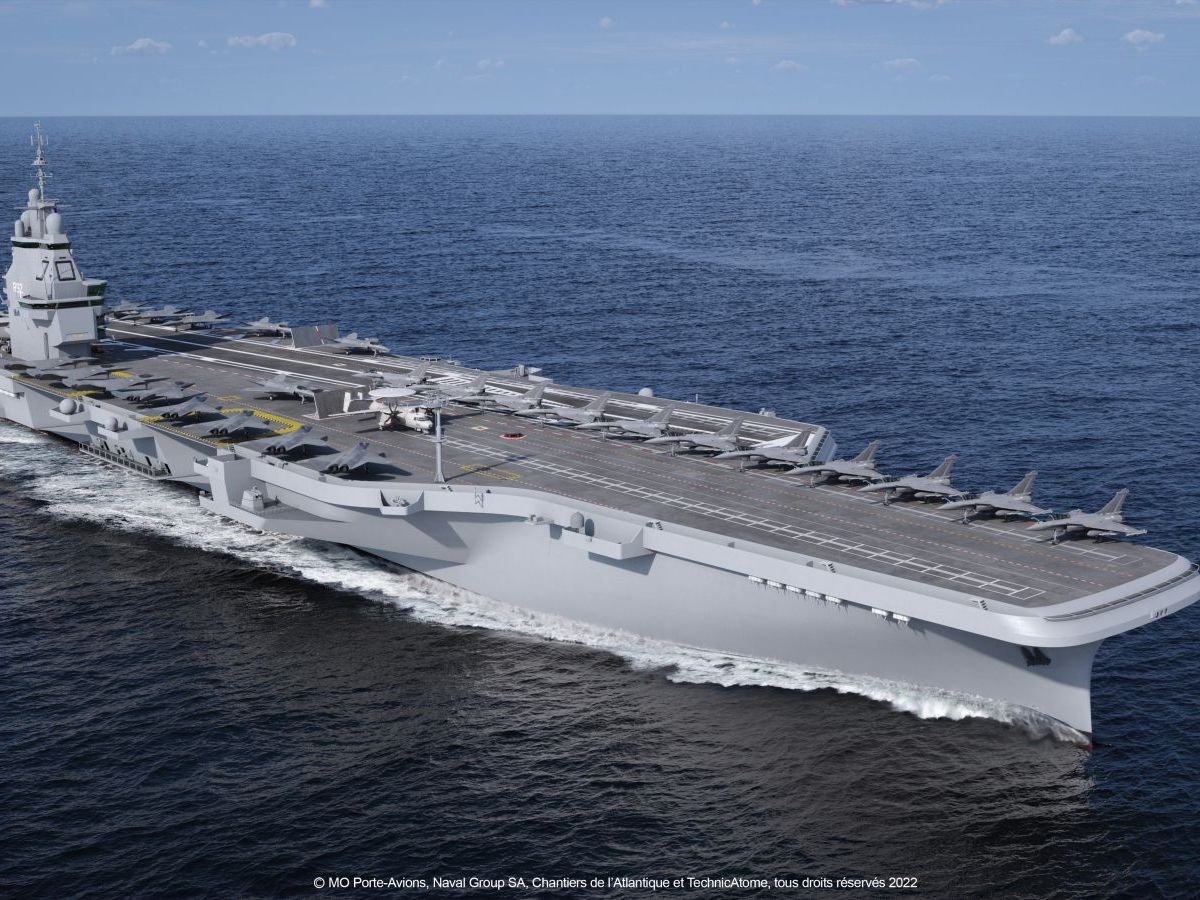
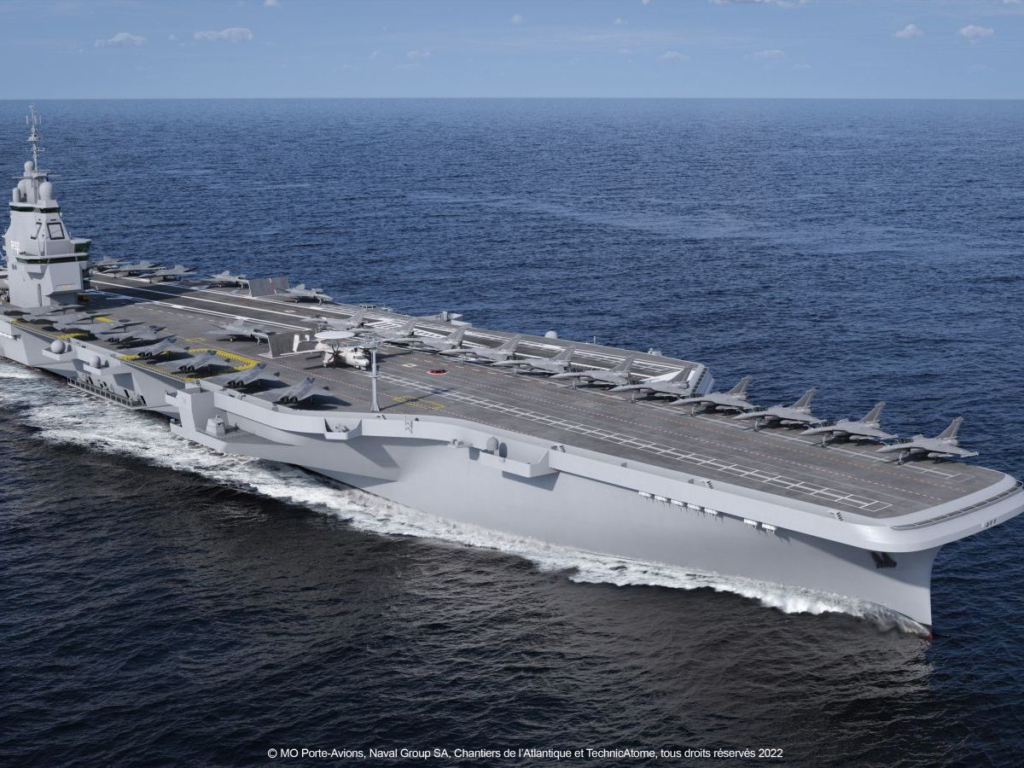
The United States is also exporting EMALS to the French Navy for use on its future nuclear aircraft carrier, PANG (Porte-Avions de Nouvelle Génération).
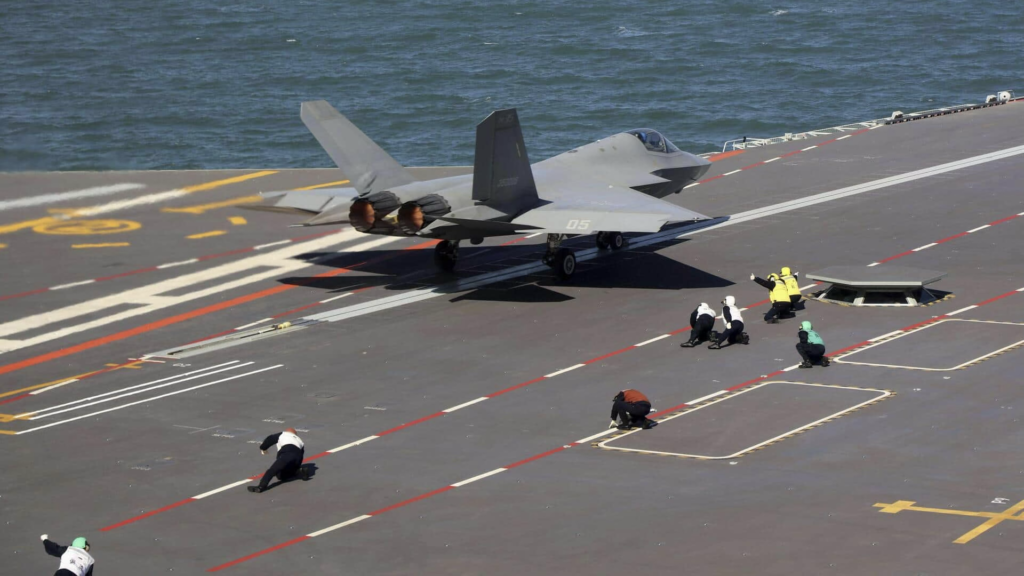
China has also developed its own EMALS for the Type 003 aircraft carrier Fujian. It has already demonstrated the capability to launch aircraft such as the J-35, J-15T, and the KJ-600 naval AWACS.
How EMALS Works
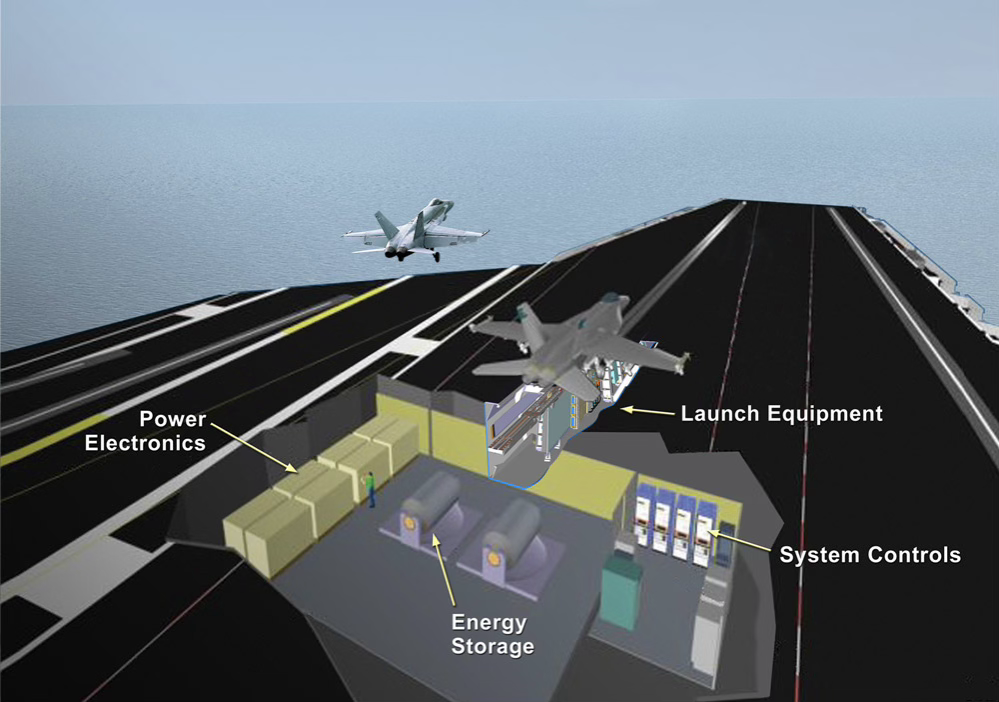
EMALS uses a linear induction motor (LIM), stored electrical energy, and advanced computer control to accelerate aircraft. It works by creating a traveling magnetic field through stator coils embedded in the deck. This field moves a carriage that accelerates the aircraft along the flight deck.
There are four main components in EMALS:
1. Linear Induction Motor (LIM)
The LIM consists of a row of stator coils that function similarly to a conventional motor’s rotor. When energized, the motor accelerates the carriage down the track. Only the section of coils around the carriage is activated at any given time, minimizing energy losses.
The 300 ft (91 m) LIM can accelerate a 100,000 lb (45,000 kg) aircraft to 130 knots (240 km/h).
2. Energy Storage Subsystem
The LIM requires a massive amount of energy in a very short time, more than the ship’s power system can directly supply.
This subsystem stores energy kinetically using rotors in four disk alternators. Each rotor can store over 100 megajoules and can be recharged within 45 seconds faster than steam catapults.
3. Power Conversion Subsystem
During launch, stored energy is released through a cycloconverter, which provides controlled frequency and voltage to the LIM.
This ensures that only the necessary stator coils are energized at any moment, improving efficiency and control.
4. Control Consoles
Operators manage the launch using a closed-loop system. Hall-effect sensors monitor performance in real time, ensuring precise acceleration.
This system maintains a constant tow force, reducing stress on the aircraft’s airframe.
Advantages of EMALS Over Steam Catapults
1. Higher Launch Energy
EMALS can deliver up to 122 MJ of launch energy compared to 95 MJ for steam catapults—a ~30% increase.
This allows the launch of heavier aircraft like AWACS and tankers with more fuel and payload.
It is also faster, with a 45-second reset time compared to 80 seconds for steam systems.
A Ford-class carrier can sustain 160 sorties per 12-hour day versus 120 sorties for a Nimitz-class carrier.
2. Reduced Weight and Volume
EMALS eliminates complex systems such as steam piping, valves, and pumps.
- Steam catapult: ~486 metric tons, ~1,133 m³
- EMALS: ~225 metric tons, ~425 m³
Steam catapults also consume ~615 kg of steam per launch, amounting to ~73,800 kg for 120 sorties.
3. Real-Time Feedback and Reduced Stress
Steam systems lack real-time feedback, often causing force spikes that stress the aircraft structure.
EMALS uses a closed-loop control system that adjusts launch parameters based on aircraft type and condition.
This reduces structural stress and maintenance requirements.
4. UAV Operations
EMALS enables the launch of UAVs and UCAVs, which struggle with STOBAR systems.
India could deploy platforms like DRDO Ghatak and CATS Warrior for strike, SEAD, and ISR missions.
It also enables carrier-based refueling UAVs like the MQ-25 Stingray and ISR platforms like Sea Avenger.
5. Increased Payload and Range
India’s current STOBAR carriers operate MiG-29K fighters, which must take off under their own power.
This limits fuel and payload capacity, reducing combat range and mission flexibility.
EMALS removes this limitation, allowing aircraft to launch at maximum take-off weight.
6. Compatibility with 5th Generation Fighters
EMALS is critical for operating 5th-generation fighters like the J-35 and F-35C, which have sensitive stealth airframes.
It provides precise and controlled acceleration required for safe launches at full weight.
The only exception is the F-35B, which uses VTOL/STOVL operations.
Limitations of EMALS
1. High Power Demand
A single EMALS launch can require nearly 100 MW of energy in just 3 seconds.
- USS Gerald R. Ford generates ~13,800 volts
- Nimitz-class carriers generate ~4,160 volts
INS Vikrant, powered by four GE LM2500 engines, produces ~88 MW far less than the 250–300 MW available on nuclear-powered carriers.
2. Reliability Concerns
Testing by Pentagon official Robert Behler revealed reliability issues.
- Expected: 4,166 cycles between failures
- Achieved: 181 cycles
This is significantly below operational requirements.
While Ford-class carriers are designed for F-35C operations, full deployment maturity is still evolving.
Meanwhile, China has demonstrated launches of J-35, J-15T, and KJ-600 from Fujian.
3. High Cost
EMALS is expensive and time-intensive to develop, requiring 10–15 years and billions of dollars.
Currently, only the U.S. and China have developed it indigenously.
France is procuring EMALS and AAG from General Atomics at an estimated cost of $1.321 billion.
India’s Experience with EMALS – INS Vishal
India first explored an EMALS-equipped supercarrier (INS Vishal / IAC-2) around 2011 under Admiral Nirmal Kumar Mishra.
The proposed carrier was a 65,000-ton, 300-meter-long vessel.
India engaged the U.S. under the Aircraft Carrier Technology Cooperation Group (2015), including discussions on EMALS under the Defence Technology and Trade Initiative (DTTI).
However, the project has faced repeated delays, primarily due to cost.
- Estimated cost: ~$20 billion
- Includes carrier construction + air wing
- Excludes carrier battle group (escorts, submarines, etc.)
The Indian Navy is currently leaning toward a modified STOBAR design based on INS Vikrant.


Future Outlook
In 2025, India’s Technology Perspective and Capability Roadmap again highlighted the requirement for:
- A new aircraft carrier
- EMALS (marked “Under Development” by DRDO)
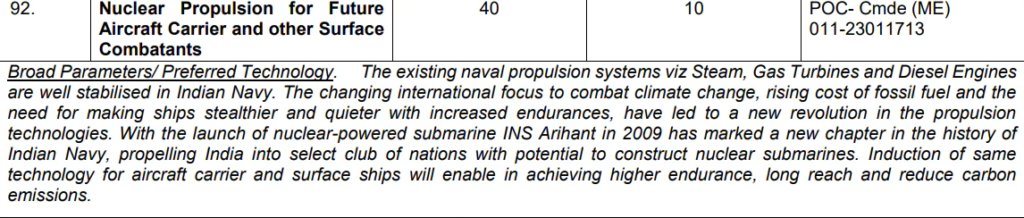
- Nuclear propulsion for future warships
If India successfully develops an EMALS-equipped carrier, it would join a very small group of nations capable of operating CATOBAR carriers with AWACS and UCAVs.