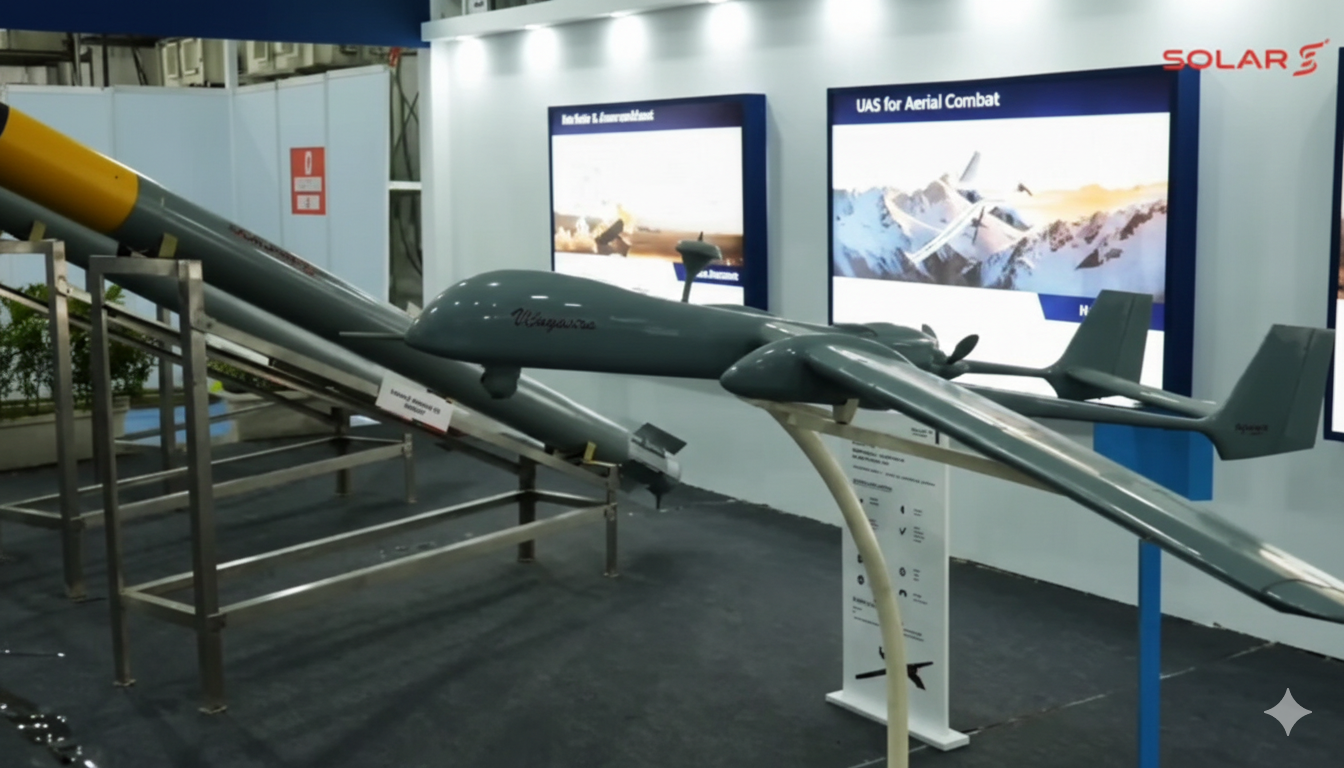
At Advantage Vidarbha 2026, Solar Industries India Limited revealed the first public glimpse of its Medium Altitude Long Endurance (MALE) UAV, named Vijayastra.
At first glance, many assumed it was an existing Indian UAV. However, a closer look suggests otherwise. This unveiling marks an important step in India’s growing private-sector participation in high-end defence aerospace systems.
Design and Configuration of Vijayastra MALE UAV
From the available image, several technical details can be identified.
The Vijayastra MALE UAV features:
- A single-engine configuration
- A twin-boom tail layout
- An airframe optimized for high altitude and long endurance
- Dedicated payload space
- A visible Electro-Optical (EO) payload system
The twin-boom configuration is common in MALE-class drones. It offers structural balance and stability during long-duration missions.
Can Vijayastra Be Armed?
Yes, it can.
Given the visible structural provisions, the UAV can potentially carry:
- Internal payloads
- External hardpoints for weapons
This opens the door for ISR (Intelligence, Surveillance, Reconnaissance) missions as well as armed strike roles.
Composite Materials: A Key Advantage
Recently, Solar Industries developed lightweight composite materials for UAV applications. It is highly likely that the same advanced composites are being used in the Vijayastra MALE UAV.
Why does this matter?
Lower structural weight leads to:
- Higher service ceiling
- Better fuel efficiency
- Longer endurance
- Reduced operational costs
In high-altitude UAV operations, weight reduction directly improves performance. Therefore, this material innovation could be a decisive advantage.
Indian Armed Forces Requirements: The 30,000 ft and 24-Hour Benchmark
The Indian armed forces are looking for a MALE UAV capable of:
- Operating up to 30,000 feet
- Achieving 24 hours endurance
Traditionally, turboprop engines are preferred for such missions. They offer better performance at altitude. However, they also significantly increase acquisition and operating costs.
As a result, piston engines are being pushed to their limits. If optimized correctly, piston-powered UAVs can offer a cost-effective alternative while meeting operational thresholds
Lessons from Foreign Systems and the Tapas Experience
Several foreign systems have claimed impressive performance numbers in brochures. However, real-world performance often tells a different story.
In some cases, platforms delivered barely 60% of their advertised capabilities.
India’s indigenous Tapas UAV came closest to tri-services requirements. Yet, it fell short by:
- 6 hours in endurance
- 2,000 feet in altitude
This gap highlights the complexity of achieving true MALE-class performance.
How Vijayastra MALE UAV Could Achieve Required Endurance
The Vijayastra uses a single-engine configuration, which reduces overall weight and fuel consumption during cruise.
This design choice offers two clear benefits:
- Lower fuel burn
- Reduced structural mass
When combined with lightweight composites, the platform could realistically achieve improved endurance and altitude performance.
In MALE UAV design, efficiency is everything. Every kilogram saved translates into longer mission time.
A Promising First Step Toward UAV Self-Reliance
The Vijayastra MALE UAV represents more than just a new drone. It reflects the growing maturity of India’s private defence sector.
Solar Industries has demonstrated the ability to:
- Rapidly iterate designs
- Invest in advanced materials
- Scale manufacturing efficiently
Backed by strong private management, skilled workers, and a clear national vision, this program could reduce India’s long-term dependence on imported UAV systems.
If developed and refined correctly, Vijayastra may become a serious contender in the MALE UAV segment.
The unveiling of the Vijayastra MALE UAV at Advantage Vidarbha 2026 signals a new phase in India’s indigenous drone development.
With a twin-boom design, single-engine efficiency, lightweight composites, and potential strike capability, the platform appears technically sound on paper.
However, the real test will be performance validation.
If Solar Industries can meet the 30,000 ft and 24-hour benchmark, Vijayastra could emerge as a credible, cost-effective, and scalable Indian MALE UAV solution.
India’s journey toward UAV self-reliance may have just taken an important step forward.