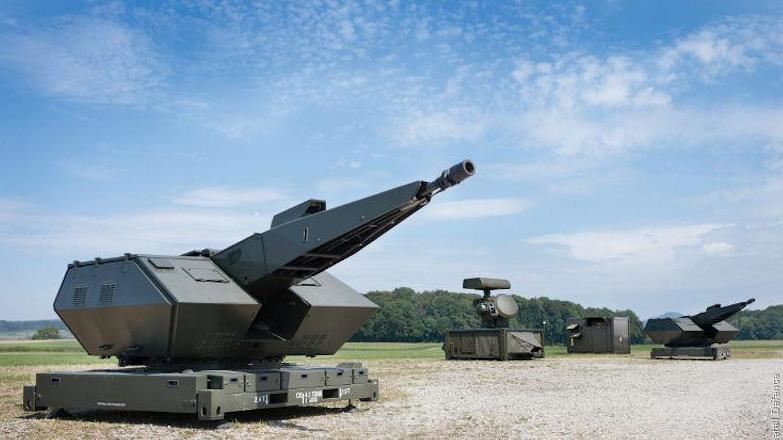
In an era where the character of warfare is being rapidly redefined by low-cost attrition most notably through the proliferation of loitering munitions and swarm drone tactics, the traditional air defence umbrella is undergoing a tectonic shift. The recent Request for Information (RFI) issued by the Directorate General of Army Air Defence (AAD) for New Generation Air Defence Guns (ADG-NG) signals a strategic pivot toward high-precision, automated terminal defence systems designed to safeguard India’s most critical assets.
The Evolution of the Threat: Beyond Kinetic Air Power
Modern aerial threats no longer consist solely of high-performance fighter jets. The contemporary battlefield is saturated with “sub-conventional” threats: cruise missiles, Precision Guided Munitions (PGMs), and increasingly sophisticated Unmanned Aerial Systems (UAS).
The AAD’s requirement for the ADG-NG emphasizes an all-weather, automated system capable of operating in environments ranging from the cryogenic altitudes of the Himalayas (-30°C) to the blistering heat of the Thar Desert (+55°C). The mandate is clear: the system must not only detect but decisively neutralize targets with a radar cross-section (RCS) so small they often evade traditional long-range SAM (Surface-to-Air Missile) batteries.
Technical Dominance: Speed, Precision, and “Smart” Kinetic Energy
The technical parameters outlined in the RFI suggest a weapon system that balances high-volume fire with surgical precision. Key specifications include:
- The 300 RPM Threshold: A minimum rate of fire of 300 rounds per minute ensures a high-density “wall of lead” necessary to intercept fast-moving cruise missiles traveling at speeds of 500 m/s.
- Ammunition Intelligence: Moving away from “dumb” shells, the ADG-NG is centered on “Smart Ammunition”. This includes programmable, pre-fragmented, and proximity-fused rounds. These projectiles are designed to explode in the flight path of a drone, creating a cloud of tungsten pellets that ensures a kill even without a direct hit.
- The “Five Engagement” Logic: A critical operational requirement is the ability to sustain more than five effective engagements via an automated loading system. In a swarm drone scenario, the ability to transition between targets without manual reloading is the difference between mission success and catastrophic failure.
The “Sudarshan” Factor: A Triumph of Indigenous Engineering
While the RFI is open to Indian vendors, the L&T Sudarshan (CIWS) stands as a formidable domestic contender that aligns seamlessly with these requirements. Developed as a sophisticated “System of Systems,” the Sudarshan integrates 3D AESA search radars and advanced Electro-Optical Fire Control Systems (EOFCS).
The Sudarshan’s ability to operate in a “passive” mode using its Thermal Imaging and Laser Range Finders to track targets without emitting radar signals makes it nearly invisible to enemy Electronic Intelligence (ELINT) units. This aligns perfectly with the RFI’s emphasis on survivability in a modern electronic warfare environment.
However, it does not offer programming of the round during fire and probably that one factor remains as unaddressed.
Strategic Autonomy through IDDM
The ADG-NG project is anchored in the DAP-2020 framework, specifically targeting a minimum of 50% Indigenous Content (IC). By fostering a domestic ecosystem for air defence manufacturing, India is reducing its historical dependency on foreign OEMs (Original Equipment Manufacturers).
This procurement also opens doors for Indian defense majors and MSMEs to innovate in the realms of GaN-based fire control radars and AI-driven Threat Evaluation and Weapon Allocation (TEWA) software.
Securing the Skies of Tomorrow
The ADG-NG is not merely a replacement for aging L/70 or ZU-23-2 guns; it is a sophisticated response to a new age of aerial volatility. As the Indian Army moves toward a more digitized and sensor-fused battlefield, systems like the ADG-NG will provide the essential “last line of defense.”
For stakeholders in the Indian defense industry, the journey from RFI to RFP (Request for Proposal) will be a litmus test for India’s “Atmanirbhar” (Self-Reliant) ambitions in high-tech kinetic weaponry.