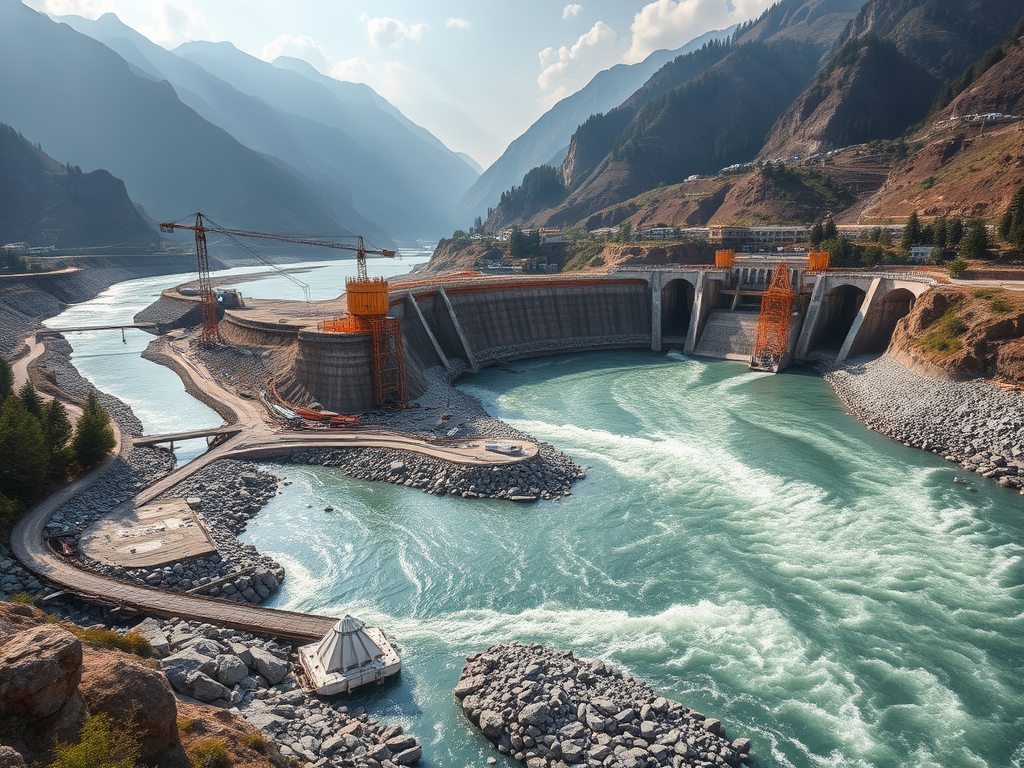
India has formally initiated work on the ₹5,129 crore Sawalkote Hydroelectric Project on the Chenab river in Jammu and Kashmir. This marks the first major new hydropower project to move forward after New Delhi placed the Indus Waters Treaty (IWT) framework in abeyance for bilateral engagements.
The development is significant not only for India’s energy security but also for regional water dynamics, as the Chenab is a core river of the Indus basin that flows into Pakistan. While the project complies with technical design norms applicable to western rivers, its timing and scale underline a clear policy shift in India’s approach to river utilisation.
NHPC Invites Bids for Sawalkote Project
State-run NHPC Limited invited construction bids on 5 February for the Sawalkote project, located across the Udhampur and Ramban districts of Jammu and Kashmir.
The project will be executed in two stages:
| Stage | Installed Capacity |
|---|---|
| Stage One | 1,406 MW |
| Stage Two | 450 MW |
| Total | 1,856 MW |
Sawalkote is designed as a run-of-the-river hydroelectric project, positioned between Baglihar upstream and Salal downstream on the Chenab. Its location allows India to optimise energy extraction from an already regulated river stretch without creating large new reservoirs.
Emphasis on Fast-Tracked Execution
Project documents show a clear focus on accelerated execution and early commissioning.
Key construction features include:
- Year-round underground works, reducing seasonal delays
- Surface construction prioritised during non-monsoon months
- Reduced but continuous activity during monsoon periods
- Equipment selection tailored for faster tunnelling and civil works
The overall construction timeline is estimated at around nine years, which is considered reasonable given the project’s scale and complex Himalayan terrain.
Environmental Clearance and Strategic Context
The Sawalkote project received approval from the Environment Ministry’s expert appraisal committee in October 2024, clearing a major regulatory hurdle.
This clearance came amid a broader government push to accelerate strategically important hydropower projects on western rivers, following the suspension of regular Indus Waters Treaty discussions after recent security developments in Jammu and Kashmir.
NHPC’s move to invite bids indicates that Sawalkote has now shifted from a long-pending proposal to an active execution phase.
Four Chenab Projects Under Direct Monitoring
Alongside Sawalkote, the Centre has issued firm timelines for four key hydropower projects on the Chenab river system.
Targeted Timelines
| Project | Capacity | Target Completion |
|---|---|---|
| Pakal Dul | 1,000 MW | December 2026 |
| Kiru | 624 MW | December 2026 |
| Kwar | 540 MW | March 2028 |
| Ratle | 850 MW | By 2028 |
Officials have been instructed to treat these projects as national priority infrastructure, with milestones and funding flows being closely monitored.
Pakal Dul: A Strategic First on a Western River
The 1,000 MW Pakal Dul project in Kishtwar is the largest hydropower project in the Chenab basin.
Key characteristics:
- Dam height: 167 metres (highest in India)
- India’s first storage project on a western river
- Enables limited regulation of water timing, not just power generation
While still within permissible uses under treaty interpretations, storage capability on a western river has historically been a point of contention for Pakistan, which prefers purely run-of-the-river designs.
Kiru and Kwar: Complementary Projects
The Kiru project, located near Pakal Dul, is a run-of-the-river dam with a height of 135 metres and is targeted for commissioning by December 2026.
The Kwar project, with a 109-metre-high dam, achieved a major milestone in January 2024, when the Chenab was diverted to enable main construction. Completion is now scheduled for March 2028.
Together, these projects create a cascade system, improving power generation efficiency across the river stretch.
Ratle and Dulhasti Stage-2 Move Ahead
The 850 MW Ratle project, featuring a 133-metre-high dam, has remained controversial due to Pakistan’s objections to its design parameters. However, river diversion through tunnels completed in 2024 indicates that execution has accelerated.
Completion is expected by 2028.
In parallel, Dulhasti Stage-2 received environmental clearance in December 2024, adding further generation capacity on the same river system.
Why These Developments Matter to Pakistan
The Chenab is a critical component of the Indus basin, which underpins Pakistan’s water security.
Indus Basin Dependence
| Indicator | Approximate Share |
|---|---|
| Pakistan’s water supply from Indus basin | ~75% |
| Agricultural dependence | Over 90% |
| Major dams and canals | Almost entirely Indus-linked |
Pakistan’s irrigation system, food security, and hydropower generation are deeply tied to predictable Chenab flows.
While India’s projects remain within technical limits, the cumulative effect of multiple dams and storage-enabled regulation gives New Delhi greater operational flexibility. This reduces Pakistan’s long-held leverage over project approvals and dispute mechanisms.
A More Assertive but Law-Aware Approach
Importantly, India has not announced any unilateral withdrawal from the Indus Waters Treaty. Instead, it has chosen to pause treaty-linked proceedings while fully utilising permissible rights under the existing framework.
The Sawalkote project, along with Pakal Dul and Ratle, reflects a more assertive, rules-based utilisation strategy rather than a confrontational one.
In Nutshell
The Sawalkote Hydroelectric Project is more than a power plant. It represents a turning point in India’s western river strategy, combining infrastructure execution, energy security, and strategic signalling.
For Pakistan, the message is subtle but clear:
India intends to fully exercise its rights on the Chenab, move faster on stalled projects, and reduce external veto points while remaining formally within treaty boundaries.
In the long term, this shift could reshape Indus basin water diplomacy, making infrastructure realities more influential than procedural disputes.
I have been repeatedly saying that Pakistan is not worried about Kashmiri people but their main focus is all the rivers, natural resources and free development which India has done in last 80 years. They are fooling Kashmiri people
Pakistan is very clear and there is cristal clean clear guidelines of the It’s Founder Jinnah, who said Kashmir is a lifeline for Pakistan, Pakistan is watching closely if they see any misbehave in the river flow,I hope the will hit this dam so Chiinab has to get it’s natural flow.
Ok piggy
🐷
Typical mind. Amicable solution will solve it. hitting the dame stone age mindset
say hii
Pakistan’s stance is good I think. If India is using Water as a tool against the enemy then they’re essentially asking for a strike.