– By Prateek Yagnik
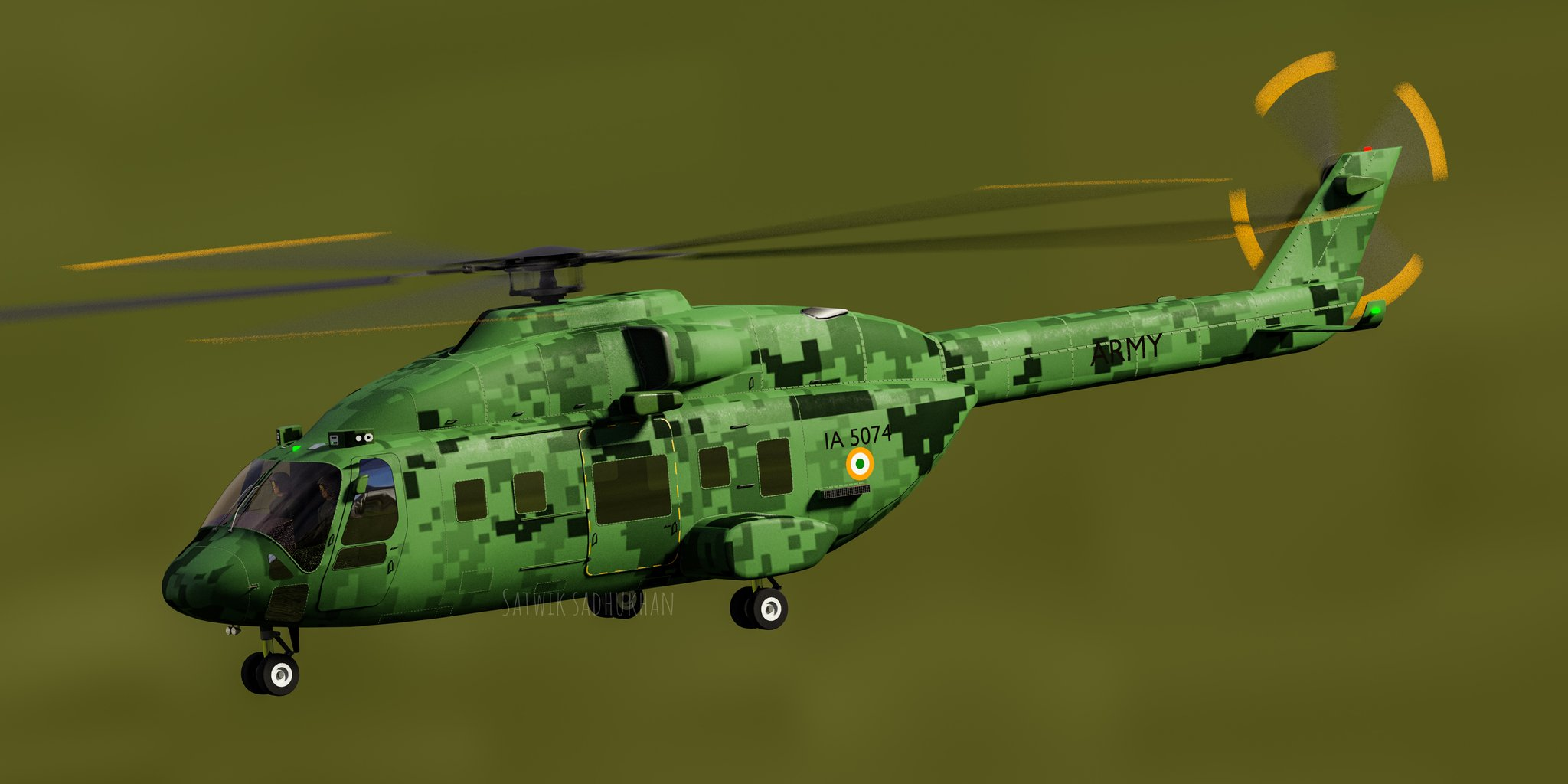
The Deck-Based Multi-Role Helicopter (DBMRH) program undertaken by Hindustan Aeronautics Limited (HAL) is a critical part of India’s Aatmanirbhar Bharat initiative in the defence and aerospace sector. This platform was developed specifically for the Indian Navy’s maritime requirements; however, its twin engine design will serve all three branches of the Indian Armed Forces.
The India Navy has had a pressing need for a modern, medium-lift, multi-role helicopter fleet capable of operating from its surface ships including frigates, destroyers and aircraft carriers. The need has been accentuated by the phase out of the older helicopters such as the Sea King. The DBMRH will fill critical capability gaps in Anti-Submarine Warfare (ASW), Anti-Surface Warfare (ASuW) and logistical support roles in the demanding high corrosion environment.
The overall requirement for this class of rotorcraft across the armed forces is about 200-400 units.
Origins & Development
The conceptual groundwork for the DBMRH began with the Medium Lift Helicopter (MLH) project in the late 2000s. By 2017, the project evolved and was relaunched as the IMRH, with a more powerful 13-ton design.
The DBMRH, at a projected 12.5-ton class, is the full marine version of the IMRH incorporating essential naval adaptation such as a folding tail boom and folding main rotor blades to minimise its storage footprint for compact storage spaces such as ship hangars and decks. The project is being designed by HAL’s Rotary Wing Research & Design Centre (RWRDC).
HAL and France’s Safran Helicopter Engines have formed a 50/50 joint venture, SAFHAL Helicopter Engines Pvt Ltd, to jointly design, develop, manufacture, and support a new generation of hight powered turboshaft engine named “Aravalli”. This collaboration has allowed HAL to participate in the design, development, and production of core engine components.
Planned Variants and Operational Roles
The DBMRH is engineered with a high degree of modularity to quickly adapt its roles, with the Indian Navy planning at least three main variants for specialized missions.
| Variant | Primary Role | Key Systems and Armaments |
|---|---|---|
| Anti-Submarine Warfare (ASW) / Anti-Surface Warfare (ASuW) Variant (Warfare/DBMRH-S) | Primary naval combat role; detection and neutralization of sub-surface and surface threats. | Dipping Sonar, Sonobuoys, Torpedoes, Anti-Ship Missiles (AShMs). |
| Special Operations Variant (DBMRH-S) | Covert insertion/extraction of special forces, Search & Rescue (SAR), and utility transport. | Multimode Surveillance Radar System. |
| Airborne Early Warning (AEW) Variant | Maritime domain awareness, surveillance, and early warning for the fleet. | Conformal AEW Radar System (Operating below 6GHz), Long-endurance capability. |
Technical Specifications and Propulsion
The technical specifications of the DBMRH are as follows:
| Feature | Specification (Projected for DBMRH) |
|---|---|
| Class / Max Take-Off Weight (MTOW) | 12.5-ton class / up to 13,000 kg (28,660 lb) |
| Powerplant | 2 x SAFHAL Aravalli Turboshaft Engines |
| Engine Power Output | Approx. 3,000–4,000 HP each |
| Passenger/Troop Capacity | 24 to 36 seated troops |
| Payload Capacity | 4,500 kg (9,921 lb) internal |
| Maximum Speed | 300 km/h (160 knots) |
| Range | 800 km |
| Service Ceiling | 6,700 m (22,000 ft) |
Design and Development Process
The latest technical document released by HAL to engage external vendors in the development process outlines rigorous standards of aerospace engineering including creating manufacturable 3D CAD models and drawings utilising Model Based Dimensioning (MBD) standards.
The key requirements include:
- Tri-Service Commonality: To streamline logistics, training, and maintenance, the platform is meant to maximize the commonality between the IMRH (Air Force/Army) and DBMRH (Navy) variants.
- High Altitude Performance: Key requirement of the platform is the ability to operate in high altitude sectors such as Kashmir, Ladakh and Arunachal Pradesh.
- Maintainability and Low Lifecycle Cost: Ease of maintenance, quick turnaround times, and modular systems that allow reduction in total cost of ownership.
- High Indigenous Content: Target of over 75% indigenous components to insulate the program from foreign supply chain risks.
Methodology for Airframe Design
To ensure structural integrity and crashworthiness under demanding flight and naval conditions, the airframe design process is to follow a rigorous digital-first approach
- Finite Element Modelling (FEM): Creation of a detailed, comprehensive digital representation (CDR) of the airframe, rotor system, and major load-bearing components.
- Finite Element Analysis (FEA): This crucial analysis phase uses the FEM model to simulate structural behaviour under various scenarios, including maximum flight loads, fatigue cycles, vibration loads, and most critically, high-sink-rate deck landing impacts.
Modular Design Concept and Drawings
Modular philosophy has been adopted for ease of ongoing customisations and maintenance.
Each primary module is designed to be self-contained and the final design package, encompassing all airframe modules, systems integration, and wiring harnesses, will require an estimated 50,000+ technical drawings for manufacturing and assembly.
Budget and Funding Structure
The IMRH/DBMRH program is a long-term strategic project, with a development phase planned for approximately 7 to 8 years from formal sanction.
The estimated overall lifecycle cost of the program is between ₹10,000 and ₹12,000 crore. The funding model is a collaborative effort between HAL and the Government of India (GoI):
| Funding Source | Contribution Percentage | Note |
|---|---|---|
| HAL Internal Funding | 30% | HAL is proactively self-funding approximately ₹4,000 crore for initial design and prototyping. |
| Government of India (GoI) | 70% | The remaining funding is contingent upon approval from the Cabinet Committee on Security (CCS). |
Armaments
The payload of the DBMRH is to be adapted to the mission requirements.:
- Hardpoints: The airframe is equipped with 2 stub wings that provide 4 external hardpoints. These hardpoints support an overall external payload capacity of up to 1600 kg.
- ASW Package: DBMRH is equipped with advanced sensors and weapons to detect and neutralize underwater threats
- Dipping Sonar: An active/passive sonar system lowered into the water to hunt submarines
- Sonobuoys: Expendable floating hydrophones dropped in the water to search for acoustic signatures of submarines.
- Torpedoes: Lightweight homing torpedoes for engaging sub surface targets.
- ASuW Package: For engaging surface combatants, the DBMRH will carry Anti-Ship Missiles.
- For self-protection, close air-support or utility missions, the external hardpoints can carry a variety of munitions:
- External Guns: The DBMRH will be equipped with 7.62mm and 12.7mm machine guns mounted on the doors or in podded configurations.
- Rockets: Pods carrying various calibre unguided rockets for ground/surface suppression.
- ATGMs: Precision Anti-Tank Guided Missiles to engage armoured land targets.
- Avionics: Beyond weapons, the platform also incorporates sophisticated avionics suite including a modern Smart Cockpit, an advanced system, 4-axis Automatic Flight Control System, Electronic Warfare (EW) suite and self-protection systems such Missile Warning Receivers and flare dispensers.
DBMRH and HAL’s Existing Fleet
The development of the DBMRH represents a significant leap for HAL, moving the focus from light platforms to the medium-lift class.
HAL Dhruv (Advanced Light Helicopter – ALH) currently the workhorse of armed forces is a 5-ton class helicopter. It was the proving ground for various indigenous technologies including the Shakti turboshaft engine which provided the technological foundation for the Aravalli engine. The Dhruv primarily serves light utility, transport, and reconnaissance roles, whereas the DBMRH/IMRH is concerned with heavy transport and high-end naval combat missions.
The HAL Prachand (Light Combat Helicopter – LCH) is a dedicated attack helicopter, weighing 5.8 tonnes. Based on the ALH platform, the LCH features tandem seating, armour, and a singular combat focus, optimized for high-altitude strike and close air support. This stands in stark contrast to the DBMRH’s core mission of multi-role transport and complex naval combat (ASW/ASuW), where payload capacity, endurance, and systems integration take precedence over agility and precision strike capability.
The DBMRH/IMRH program will allow India to operate in the crucial medium-lift category which has been the exclusive domain of foreign platforms thus far.
Global Competition
The DBMRH is benchmarked against and designed to compete with the world’s leading medium-lift and naval multi-role platforms:
| Helicopter Platform | Country of Origin | Role Classification | Estimated Unit Price (US$M) |
|---|---|---|---|
| AgustaWestland AW101 (Merlin/Commando) | Italy/UK | Multi-Role, Naval, Transport | $29.00M |
| Airbus Helicopters H225M (Caracal) | France | Long-Range Tactical Transport, Naval | $35.00M |
| NHIndustries NH90 | Europe (Multinational) | Tactical Transport, Naval Frigate Helicopter | $35.00M |
| Sikorsky S-92 (H-92 Superhawk) | USA | Medium-Lift, Naval, Utility | $30.00 M |
| Mil Mi-38 | Russia | Medium-Lift, Transport | $16.00M |
| Changhe Z-18A | China | Medium-Lift, Naval, Transport | $35.00M |
The Deck-Based Multi-Role Helicopter (DBMRH) program is not just an effort to replace India’s ageing roto-winged aircrafts, but it is a crucial stepping stone in the ongoing defence indigenization program. India has leveraged its strategic partnership with Safran to fill its capability gaps with the Aravalli engine. This project will allow flourishing of indigenous capability to design, develop, and manufacture complex 12.5-ton helicopters.
Set for formal induction in 2032, it is imperative for all stakeholders from the government, HAL and the armed forces to rally behind the program to ensure successful completion. This program will not only plug critical gaps in India’s naval requirements, but also has huge export potential.