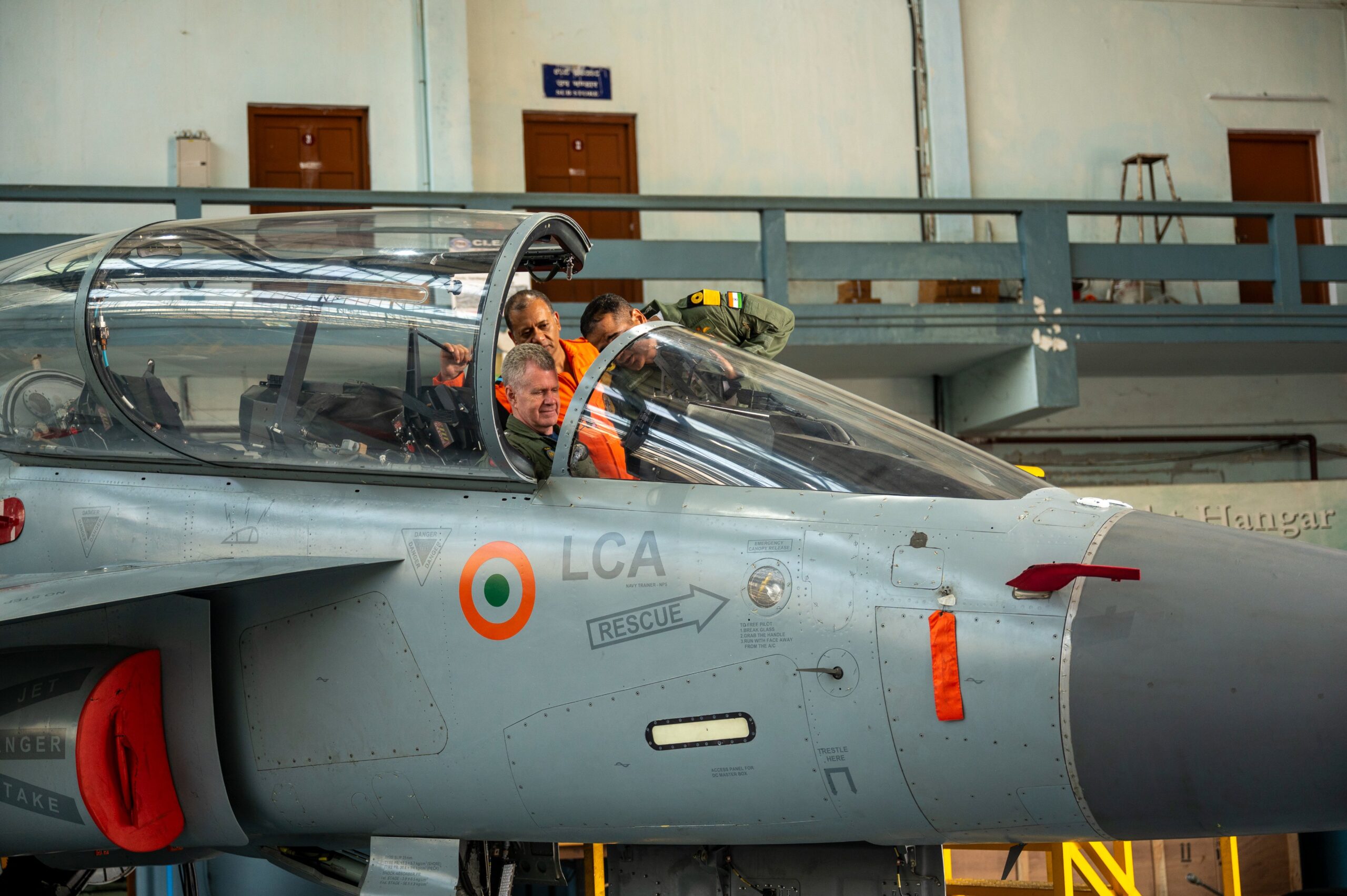
A recent photograph shared by the United States Navy has sparked fresh debate around India’s Naval LCA program. The image shows United States Indo-Pacific Command Commander Admiral Samuel J. Paparo inspecting the Naval LCA NP-5 during his February 2026 visit to India.
At first glance, this may appear routine. However, in defense diplomacy, symbolism matters. The aircraft on display was NP-5, a carrier-capable prototype designed for ski-jump take-off and arrested recovery. The timing and the source of the photograph shared by the US Navy have triggered discussions across strategic circles.
This article examines what the photograph really means, the past US interest in the platform, and the realistic future of India’s Naval LCA.
Was the United States Ever Interested in the Naval LCA?
At one point, the US Navy had a requirement for a trainer aircraft. During that period, India explored offering a Naval LCA-based trainer variant. However, the probability of the United States directly purchasing a fighter or trainer aircraft from India was always extremely low.
Defense exports into the US market are structurally difficult. Unless a country is deeply embedded in NATO industrial ecosystems, such outcomes remain unlikely. Even in India’s case—despite improving bilateral ties the pathway was complex.
A joint venture model, where the aircraft could have been co-produced in the United States with an American defense major, might have created an outside chance. But by the time discussions matured, India was not positioned to enter such an advanced industrial arrangement.
Defense collaboration at this level requires synchronized effort from:
- The Ministry of External Affairs
- The Ministry of Defence
- The armed forces
- Domestic industry
- Strategic media and policy ecosystems
Such integration was not fully aligned at that stage and to a great extent even now remain missing.
A Diplomatic Gesture, Not a Procurement Signal
Viewed objectively, the photograph represents standard defense diplomacy. Admiral Paparo was in Bengaluru for broader engagements. Showing him the Naval LCA was expected.
Interestingly, the US Navy’s social media messaging subtly highlighted that the aircraft operates with an American-origin engine. That subtle detail reinforces industrial linkages without signaling procurement intent.
There is no credible indication that the United States is evaluating the Naval LCA for induction. The optics are diplomatic, not transactional.
The Bigger Question: What Is the Future of the Naval LCA?
The more relevant discussion concerns the aircraft’s role within the Indian Navy.
Reports suggest that the Indian Navy is moving forward with additional acquisitions of the Dassault Rafale M to equip its aircraft carriers. If these inductions proceed at scale, the logic of pushing a twin-engine deck-based fighter development program weakens significantly.
The Naval LCA, in its current configuration, does not meet the Indian Navy’s operational requirement of:
- Four BVR missiles
- Two drop tanks
- Two short-range missiles
- Approximately 2.5 hours of endurance
This performance envelope has been central to naval expectations. Unfortunately, the Naval Tejas platform cannot fully satisfy it.
Could the Naval LCA Become “Navy’s Trainer?”
That remains the only realistic operational pathway.
However, there is a critical constraint: engine supply. The Indian Air Force has placed an order for approximately 180 Tejas Mk1 variants. Execution of these orders is already constrained by engine delivery timelines.
If the Indian Navy were to place Naval LCA trainer orders today, production capacity would struggle to accommodate them. Engine bottlenecks would prevent rapid execution.
A small window could emerge in the future:
- Once the Indian Air Force’s Tejas Mk1 orders are largely fulfilled.
- Once Rafale M deliveries to the Indian Navy stabilize carrier air wings.
At that point, if the Navy identifies a requirement for a deck-based trainer, a limited batch of Naval LCA-standard aircraft could become viable.
Strategic Significance Beyond Induction
Even if it never enters large-scale service, the Naval LCA has already achieved critical objectives:
- Proved India’s ability to design and test carrier-capable aircraft
- Generated valuable data for future naval fighter programs
- Built institutional knowledge in arrested recovery, reinforced landing gear, and deck operations
However, The photograph of Admiral Samuel J. Paparo with the Naval LCA NP-5 is best understood as diplomatic signaling rather than a procurement hint. The United States is not entering India’s fighter market as a buyer.
The real conversation lies within India: whether the Naval LCA transitions into a niche trainer role or remains a technology demonstrator.
In defense programs, not every aircraft is meant for mass induction. Some platforms exist to build capability for the next generation.
The Naval LCA may well be one of them.