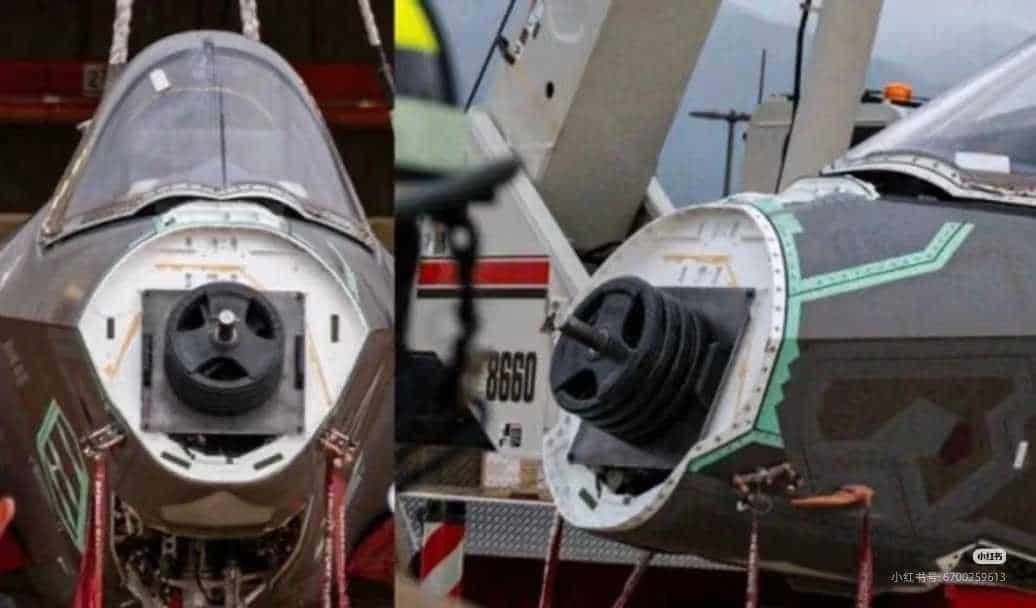
Reports suggest that some F-35 Lightning II fighters may be delivered to the U.S. military without a radar installed. If true, this would be linked to delays in integrating the new AN/APG-85 radar, which is part of the larger Block 4 upgrade program.
Image however is “a photo from a CDDAR recovery drill”
The F-35 Joint Program Office has neither confirmed nor denied the claim. However, publicly available information strongly indicates that at least some Lot 17 aircraft are being built to accommodate the new radar rather than flying with the older AN/APG-81.
This raises an important question:
Are radar-less F-35s a crisis or simply a production management decision?
Let us examine the issue carefully.
What Is Happening With the F-35 Radar?
The new AN/APG-85 radar is a key part of the Block 4 modernization package. It is expected to:
- Deliver greater power output
- Improve electronic warfare integration
- Use modern gallium nitride (GaN) technology
- Offer enhanced air-to-air and air-to-ground performance
However, Block 4 has faced major delays and cost growth. Government reports have previously stated that the upgrade package is years behind schedule and billions over budget.
At the same time, integration of the APG-85 requires structural changes in the forward fuselage. A common mounting system for both the old APG-81 and new APG-85 reportedly does not yet exist.
As a result, aircraft production appears to be continuing while radar integration catches up.
Why Would the U.S. Accept F-35s Without Radars?
Under normal manufacturing conditions, a missing major subsystem would cause a production line stoppage. In aerospace, halting the line is extremely costly and disruptive.
However, these are not normal times.
Global supply chains remain under strain. Semiconductor availability, advanced materials, and skilled labor shortages continue to affect defense manufacturing worldwide.
In such conditions, manufacturers often adopt a different strategy:
- Continue building the airframe
- Install structural placeholders
- Integrate missing systems later
This approach preserves industrial stability. It also prevents cascading delays for domestic and foreign customers.
Therefore, accepting radar-less jets may be a calculated industrial decision rather than a capability failure.
Is a Radar-Less F-35 “Blind”?
The short answer is no but its capabilities are reduced.
The F-35 was designed as a networked combat aircraft. It relies heavily on data fusion and secure communications.
Even without its own radar, an F-35 can:
- Receive radar data from other F-35s via MADL
- Use Link 16 for shared situational awareness
- Operate with passive sensors like DAS and EOTS
- Benefit from offboard targeting platforms
However, the aircraft would lose:
- Independent radar search capability
- Full electronic attack power
- Maximum survivability flexibility
In simple terms, the jet would not be useless but it would be tactically constrained.
The Deeper Issue: Block 4 and Power Margins
The radar situation cannot be viewed in isolation.
The APG-85 demands significantly more electrical power. Reports indicate that the radar may require around 82 kilowatts. This has forced upgrades to the F135 engine and thermal management systems.
In 2023, the Joint Program Office admitted that the engine’s power generation margins had been under-specified from the start.
Therefore, radar delays are part of a larger modernization challenge involving:
- Technology Refresh-3 (TR-3)
- Thermal cooling upgrades
- Engine power enhancements
- Electronic warfare updates
The real concern is not whether a few aircraft lack radars today. The real issue is whether Block 4 can be delivered on schedule and within a stable configuration framework.
Industrial Reality: The U.S. Cannot Pivot Away
Unlike smaller customers, the United States cannot simply switch platforms to pressure Lockheed Martin.
The F-35 is:
- The backbone of U.S. tactical aviation
- The primary fifth-generation production line
- Integrated across three services
- Exported to 19 partner nations
There is no parallel stealth fighter production alternative.
Therefore, maintaining production continuity often becomes a strategic necessity. Smaller air forces or Import dependent countries can look other ways.
How Rivals Will Use This Narrative
Competitors and critics will likely use this development to question the F-35 program’s credibility.
However, it is important to note that:
- The F-22 underwent heavy retrofits
- The B-21 uses concurrency strategies
- Even commercial aircraft often receive deferred upgrades
The difference is scale. The F-35 is the most scrutinized defense program in modern history.
Every delay becomes a headline.
Strategic Implications
If radar-less deliveries are confirmed, the implications are likely:
- A production continuity decision
- A temporary configuration gap
- A retrofit requirement later
- Increased long-term integration costs
It does not indicate program collapse.
However, it does highlight the complexity of upgrading a fifth-generation fighter while simultaneously producing it at scale.
The question is not whether radar-less F-35s are ideal. They are not.
The real question is whether continuing production while upgrades mature is the least disruptive option.
Modern defense programs are no longer simple hardware projects. They are evolving software-hardware ecosystems. Delays in one subsystem can ripple across engines, cooling systems, avionics, and structural design.
The F-35 radar issue reflects that reality.
Whether this decision proves wise will depend on how quickly the APG-85 and Block 4 upgrades stabilize.
Until then, what we are witnessing is not failure — but the strain of modern aerospace complexity meeting geopolitical urgency.