For the first time, Armenia has publicly showcased a range of advanced Indian-made weapon systems now operational with its armed forces. The display included the Akash-1S air defence system, Pinaka multi-barrel rocket launchers, ATAGS towed artillery guns, and truck-mounted 155 mm howitzers, all fielded as part of Armenia’s ongoing military modernisation.
The showcase coincided with Chief of Defence Staff General Anil Chauhan’s four-day visit to Armenia in early February, underlining the rapid deepening of defence cooperation between New Delhi and Yerevan. More importantly, it signalled India’s transition from a largely import-dependent military to a credible and reliable defence exporter whose systems are now deployed in active, real-world security environments.
This is not a ceremonial partnership. These platforms are operational, integrated, and intended to address specific capability gaps exposed in Armenia’s recent conflicts.
Akash-1S: The Air Defence Layer Armenia Was Missing
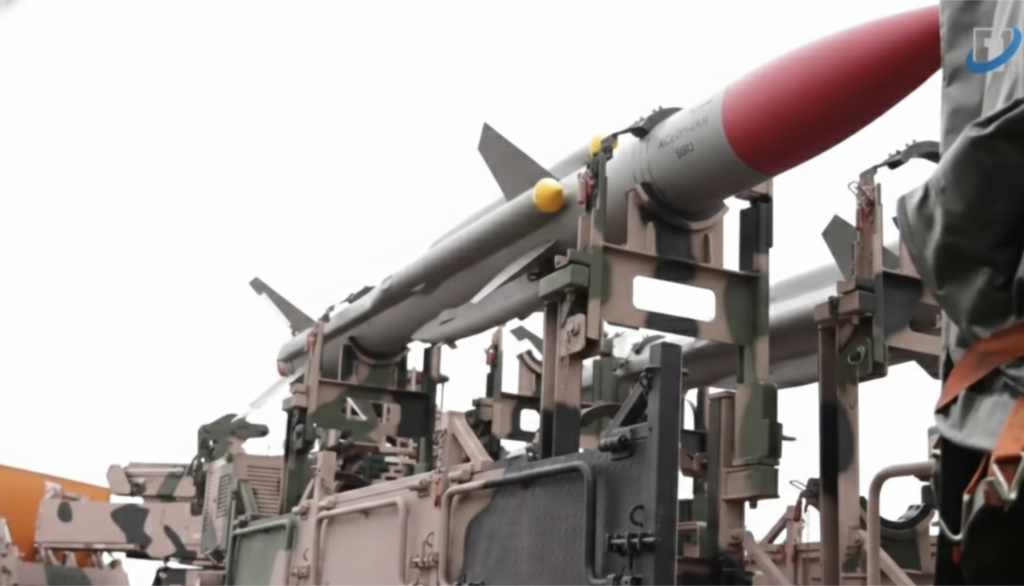
Among the systems displayed, the Akash-1S surface-to-air missile system stands out as the most strategically significant.
During earlier engagements between Armenia and Azerbaijan, the absence of a robust medium-range air defence layer proved costly. Loitering munitions and armed UAVs most notably the Bayraktar TB2 operated with near impunity, shaping the battlefield in Azerbaijan’s favour. A system in the Akash category was arguably the most critical missing piece in Armenia’s air defence architecture.
That equation has now changed.
Akash-1S provides all-weather, multi-target engagement capability, designed to counter aircraft, helicopters, cruise missiles, and increasingly relevant UAVs and loitering munitions. In Indian service, the system has earned a reputation during Operation Sindoor, where it was informally referred to as a “Turkish drone slayer”, a reflection of its effectiveness against platforms of the same class that once dominated contested airspace elsewhere.
For Armenia, Akash-1S restores a measure of airspace denial and deterrence, forcing adversaries to rethink the previously uncontested use of drones and stand-off aerial assets.
Pinaka MLRS: Long-Range Firepower and Area Denial
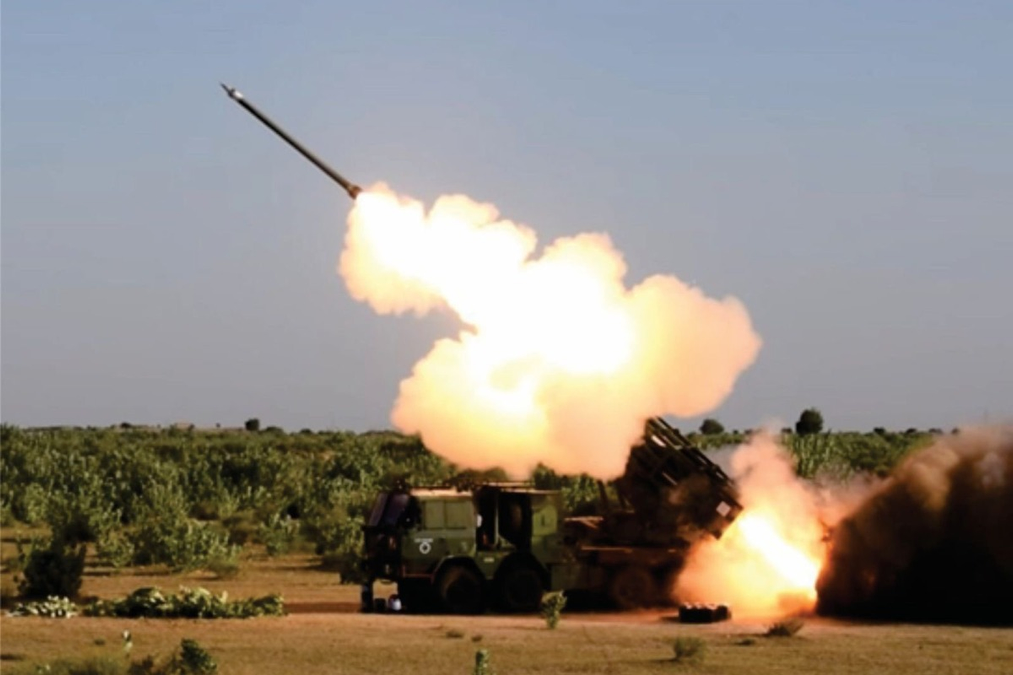
The second major capability enhancement comes from the induction of the Pinaka multi-barrel rocket launcher system, which gives Armenia a modern long-range shoot-and-scoot artillery capability.
Pinaka is designed for rapid saturation fire, capable of delivering a high volume of rockets over a wide area before relocating to avoid counter-battery fire. This makes it particularly suited for area denial, suppression of enemy formations, and deep strike roles.
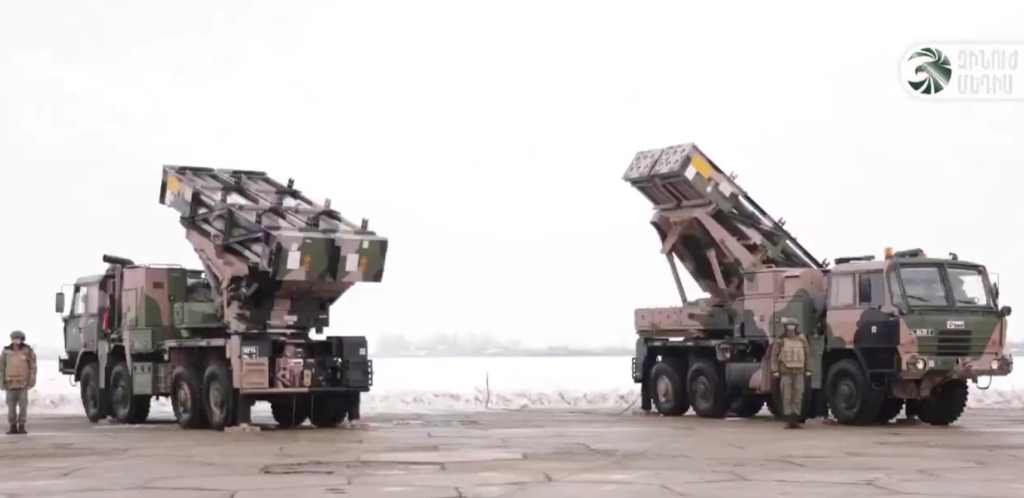
Importantly, Armenia is set to receive both unguided and guided variants of Pinaka rockets, offering flexibility between massed fire and precision strikes. The ammunition supply will be supported by Solar Industries, a key Indian defence manufacturer that has emerged as a major player in advanced rocket and energetic materials.
In mountainous and contested terrain, Pinaka significantly enhances Armenia’s ability to shape the battlespace at extended ranges.
ATAGS and Truck-Mounted Howitzers: Artillery Modernisation
Armenia’s artillery arm has also received a major boost through the induction of ATAGS (Advanced Towed Artillery Gun System) and truck-mounted 155 mm howitzers.
ATAGS represents one of the most advanced towed artillery systems in its class, offering:
- Extended firing range
- High burst and sustained fire rates
- Improved accuracy through modern fire-control systems
Complementing this are truck-mounted artillery guns, which provide greater mobility and faster deployment compared to traditional towed systems. These platforms are particularly valuable for rapid redeployment and survivability in a counter-battery environment.
Additionally, modern optics, sights, and fire-control systems delivered alongside the guns enhance accuracy, night-fighting capability, and integration with surveillance and targeting assets.
India’s Emergence as a Defence Exporter
The Armenian showcase is significant not merely because Indian systems were displayed but because they were displayed as operational weapons, integrated into a foreign military’s doctrine and force structure.
This marks a shift in India’s global defence posture:
- From licensed production to indigenous design
- From domestic prolonged trials to export-proven systems
- From political intent to operational credibility
For Armenia, these acquisitions address real battlefield lessons. For India, they reinforce a growing reputation as a dependable supplier that delivers functional, combat-ready platforms, not just promises.
As geopolitical alignments evolve, this partnership demonstrates how Indian defence manufacturing is beginning to translate industrial capability into strategic influence—quietly, but decisively.