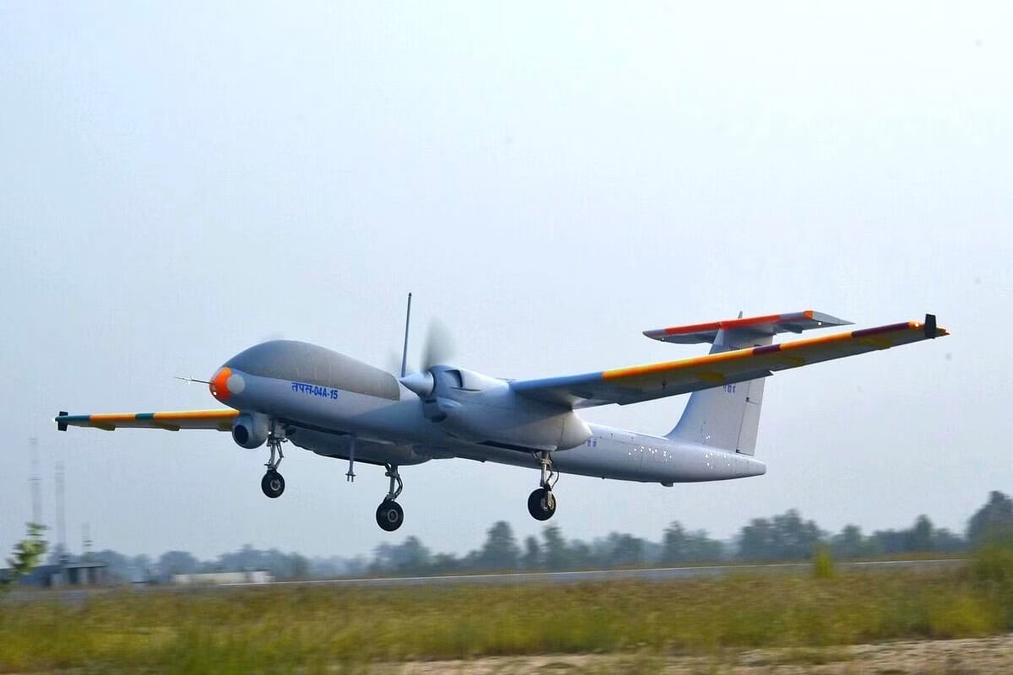
Solararised Tapas for India’s Male Drone Dream
Solar Defence & Aerospace has emerged as the L1 bidder for the design and development of an experimental airframe (Solarised Tapas UAV) using high-performance prepreg composites under the IUAS programme. The company secured the top position with a bid of ~₹15 crore. It outbid Raphe mPhibr and BAe-HAL Software Ltd. in a competitive development contract.
This project focuses on developing a structurally optimised airframe for a Medium Altitude Long Endurance UAV. Importantly, the programme emphasises advanced composite materials to reduce structural weight. At the same time, it aims to meet stringent military airworthiness standards.
Solararised Tapas :Why Advanced Composites Matter for MALE UAVs
High-performance prepreg composites allow better weight control and higher structural efficiency. As a result, UAV endurance and altitude performance improve significantly. Moreover, prepregs offer better repeatability and quality compared to conventional composite methods.
Solar Defence is known for improving upon the technologies it receives. Therefore, this project is unlikely to remain limited to baseline compliance. Instead, it is expected to deliver incremental improvements in design maturity and manufacturability. Consequently, the entire MALE drone ecosystem stands to benefit.
TAPAS UAV and the Challenge of Excess Weight
The TAPAS UAV was originally created by DRDO as India’s flagship MALE platform. However, over time, the platform has been criticised for being overweight. This excess weight directly limits endurance and operational ceiling.
In this programme, DRDO and DcPP have enabled industry participation. In this case, Solar Defence will redesign the airframe using improved materials. As a result, the UAV can become significantly lighter. A lighter airframe directly translates into higher endurance and better altitude performance.
Engine Limitations and the Altitude-Endurance Tradeoff
Historically, India has remained dependent on Israel in the MALE UAV category. OEMs often promised high performance. However, they failed to deliver platforms that met tri-service requirements. The desired benchmark remains 24 hours of endurance and an operational altitude of 30,000 feet.
Achieving these specifications is difficult with piston engines. Typically, piston engines are optimised for operations between 15,000 and 18,000 feet. Therefore, endurance and altitude both suffer beyond this range.
TAPAS uses a twin-engine configuration. In theory, this setup can achieve higher altitudes. However, it can only do so if the airframe weight is reduced significantly. This is precisely where Solar’s redesigned composite airframe becomes critical.
Indigenous Engines and a Complete MALE Ecosystem
Another major limitation has been engine dependence. Most MALE UAV engines rely on foreign OEMs. These OEMs, in turn, depend on supply chains linked to Canada or China. This dependence creates long-term strategic vulnerabilities.
VRDE is now developing an indigenous engine for the MALE category. If Solar becomes the DcPP for this engine as well, the ecosystem becomes far more comprehensive. Together, an indigenous airframe and an indigenous engine would make India largely self-reliant in this category.
Long-Term Procurement and Future Growth
In the first phase, India plans to procure 87 MALE UAVs. Over time, this requirement could exceed 300 platforms. Additionally, the same design may evolve into HALE configurations.
Future variants may use turboprop engines for extended endurance. Eventually, turbojet engines could support high-altitude and high-speed roles. Therefore, the current IUAS airframe programme is not a standalone effort. Instead, it forms the foundation of a scalable unmanned aviation roadmap.
Strategic Impact on India’s Drone Industry
By winning this contract, Solar Defence & Aerospace strengthens its position as a serious aerospace design house. More importantly, the programme supports long-term capability building. As domestic firms refine composite airframe technologies, knowledge flows across multiple UAV programmes.
Ultimately, this shift reduces foreign dependence and strengthens India’s Atmanirbhar MALE UAV ecosystem. Over time, lighter airframes, indigenous engines, and scalable designs will redefine India’s unmanned aerial capabilities.