
-By Aditya Baghel
The RELOS Agreement as a Pivot of Strategic Autonomy and Continental-Maritime Integration
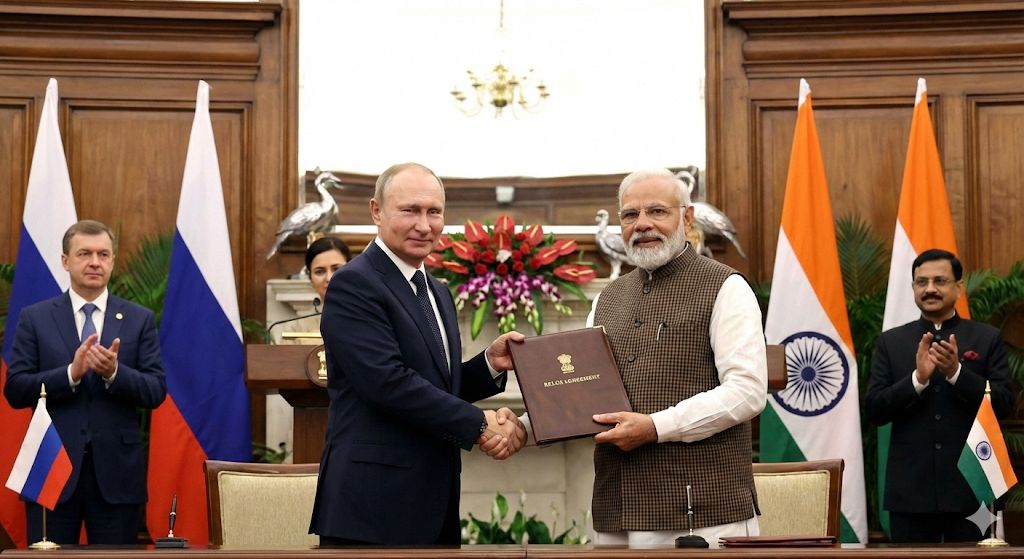
The Reciprocal Exchange of Logistics (RELOS) agreement between India and Russia represents a critical calibration of India’s “Strategic Autonomy.” It is not merely a logistical convenience but a geopolitical maneuver that integrates India’s maritime strategy in the Indian Ocean with its continental ambitions in Eurasia and the Arctic. By formalizing this pact, New Delhi successfully counterbalances its growing Western defense integration (via LEMOA and Quad) while simultaneously diluting Russia’s deepening dependence on Beijing, thereby securing a multipolar order in the Indo-Pacific.
The Strategic Context: The ratification of the RELOS agreement by the Russian State Duma in December 2025, on the eve of President Vladimir Putin’s visit to New Delhi, marks a watershed moment in the “Special and Privileged Strategic Partnership.” For years, India has signed logistics agreements with Western powers—the U.S. (LEMOA), France, Australia, and Japan. The absence of a similar pact with Russia—India’s largest defense supplier—was a glaring anomaly. RELOS corrects this asymmetry, signaling that while India looks West for technology and capital, it looks North for strategic depth and energy security.
Beyond Refueling and Repair: On the surface, RELOS is an administrative arrangement. It simplifies the procedure for Indian and Russian warships and aircraft to use each other’s military facilities for refueling, supplies, and maintenance. However, an in-depth analysis reveals three deeper layers of significance:
Operational Fluidity: It eliminates the bureaucratic friction of case-by-case clearances. For a navy like India’s, which operates Russian-origin platforms (e.g., INS Vikramaditya, Talwar-class frigates, Kilo-class submarines), access to original Russian ports for maintenance is operationally vital.
Geographic Reach: The agreement covers “ports, bases, and military installations.” For Russia, this opens the door to the warm waters of the Indian Ocean. For India, it unlocks the frozen frontiers of the Arctic and the Russian Far East.
Interoperability: It institutionalizes a level of trust required for complex joint maneuvers, moving beyond ceremonial exercises to sustained, long-range deployments.
The Great Balancing Act:
The Arctic Frontier: India’s New Northern Flank
This is perhaps the most forward-looking aspect of the deal. Climate change is opening the Northern Sea Route (NSR), a shipping lane that connects Europe and Asia faster than the Suez Canal.
RELOS grants the Indian Navy access to Russian Arctic ports (like Murmansk) and Far East ports (like Vladivostok). This ensures India is a stakeholder in the emerging Arctic trade routes and energy extraction projects, rather than a bystander.
It allows India to project power well beyond the Malacca Strait, reaching into the North Pacific where it can monitor geopolitical shifts near the Bering Strait.
Russia in the Indian Ocean: Balancing the Great Power games
China has been aggressively expanding its footprint in the Indian Ocean Region (IOR) through bases in Djibouti and port projects in Pakistan (Gwadar) and Sri Lanka (Hambantota).US has its bases all over mideast ,SE Asia and Diego Garcia
By granting Russia access to Indian ports, New Delhi invites a friendly, non-Chinese ,non-western great power into the IOR. A Russian naval presence in the Indian Ocean complicates China’s strategic calculus. It reminds Beijing that the IOR is not a bipolar contest between China and the U.S., but a multipolar space where Russia and India also have equity.
Balancing the “Quad” Dilemma:
India is often criticized by Russian hardliners for its membership in the Quad (India, US, Japan, Australia).
RELOS serves as a potent diplomatic signal to Moscow that India’s alignment with the West is not at the expense of its relationship with Russia. It proves that India operates on a “hub-and-spoke” model where it can maintain distinct, compartmentalized strategic relationships.
Future Perspective: The Horizon of Cooperation
The Chennai-Vladivostok Maritime Corridor:
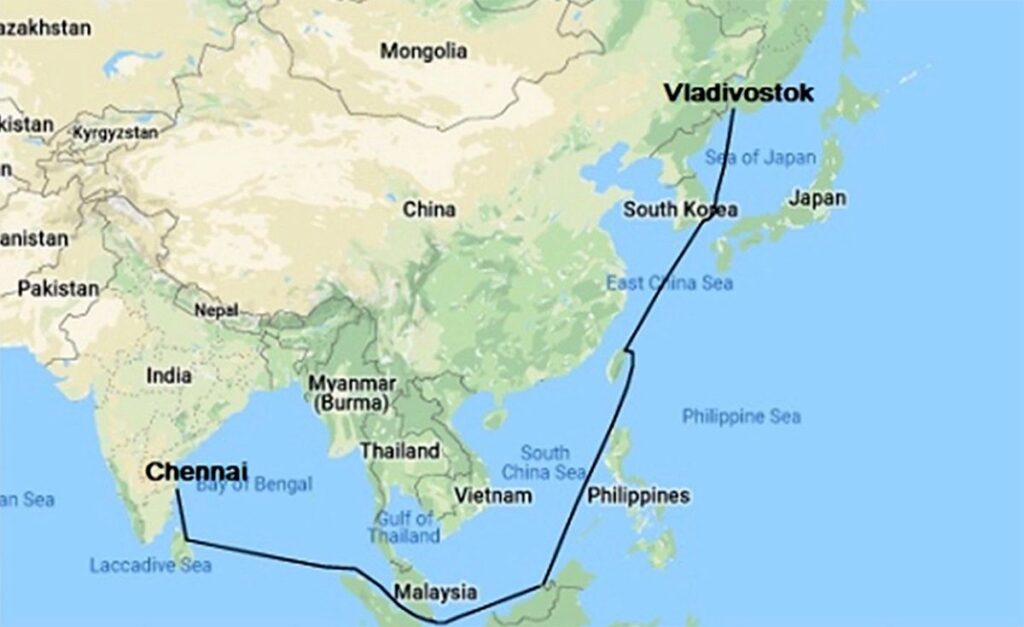
RELOS will be the security backbone of the proposed Chennai-Vladivostok maritime trade corridor. As merchant traffic increases between these two cities, the ability of the Indian Navy to dock and refuel at Vladivostok will be essential for securing this trade route against piracy or hostile interdiction.
Balancing Chinese influence : As Russia faces hostile relations with the West, it has drifted closer to China. A robust India-Russia defense partnership, anchored by RELOS, gives Moscow an alternative. It allows Russia to diversify its Asian partnerships, preventing an over dependence on China. In the future, we may see many multilateral partnership frameworks emerging in the Far East led by Russia and India to provide an alternative to Chinese and Western models.
Joint Arctic Exploration: Expect future collaboration to move from logistics to active joint exploration. Indian ONGC Videsh Ltd. may see increased protection and logistical support for its investments in Russian oil fields (Sakhalin-1) through this military proximity.
The RELOS agreement is a masterclass in realist diplomacy. For India, it is an expansion of its strategic perimeter from the Indian Ocean to the Arctic. For Russia, it is a reassertion of its status as a global power with reach into the Indian Ocean.