~ By Shreedhar Singh
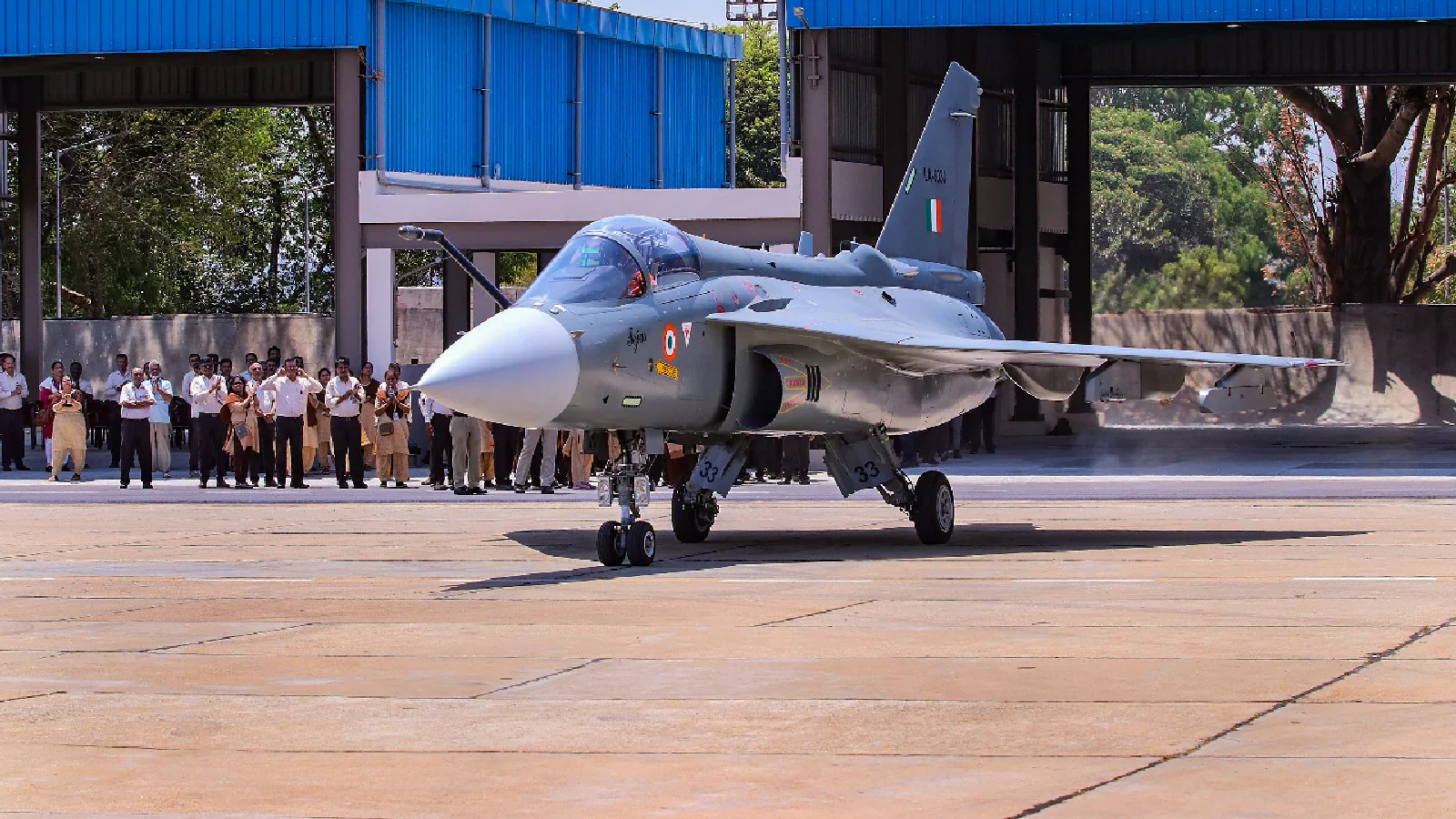
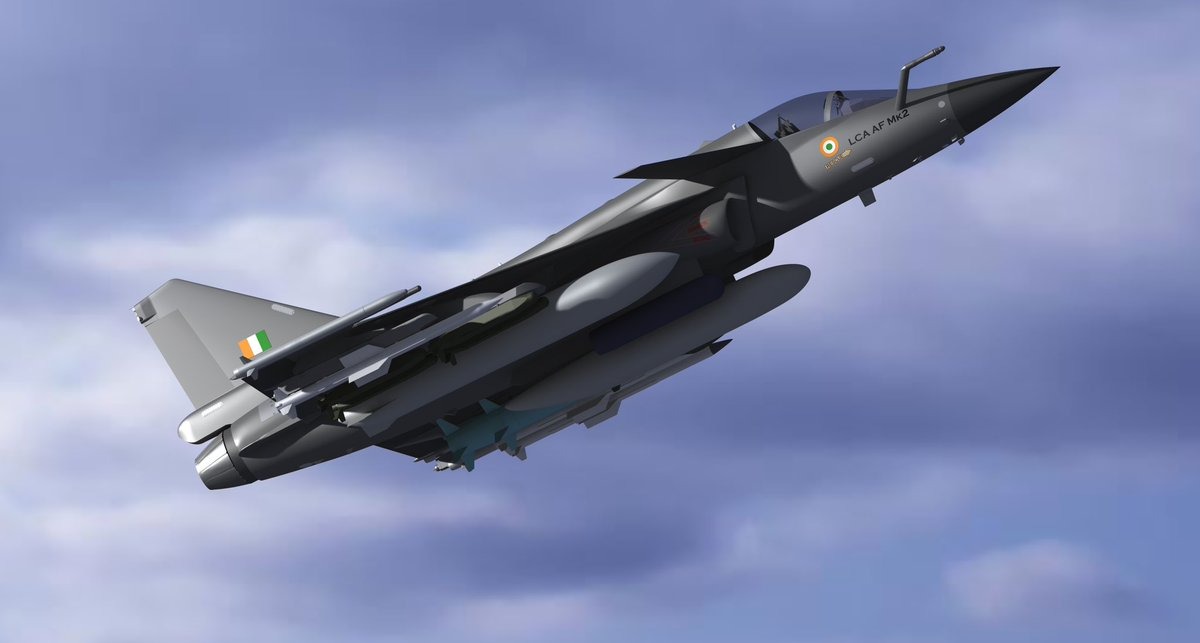
Tejas Mk2 should not be viewed merely as another fighter aircraft program. It represents an important technological and industrial bridge between the Tejas Mk1A and India’s fifth-generation Advanced Medium Combat Aircraft (AMCA). The Tejas Mk2 is a stepping stone to the AMCA, with everything from the engine to the sensors being validated on the Mk2.
Beyond providing the Indian Air Force with a more capable 4.5+ generation fighter, the Mk2 program will allow India to mature advanced avionics, sensors, propulsion integration, manufacturing techniques and low-observable design practices in a flying fighter platform. The experience, technologies and industrial capabilities developed through this program can subsequently reduce development and integration risks for AMCA.
Tejas Mk2 will act as a workhorse for the IAF. It will be a true 4.5+++ generation aircraft, coming with advanced sensor suites like a GaN-based AESA radar, IRST, MAWS and an Advanced Unified Electronic Warfare Suite (this system combines a radar warning receiver and an active threat jammer). Tejas Mk2 will feature a GaN-on-SiC AESA radar with a TSA antenna. The same technology will be implemented on the AMCA radar and the Virupaksha radar for the Super Sukhoi, and the AMCA IRST will also be inspired by the Mk2 IRST sensor.
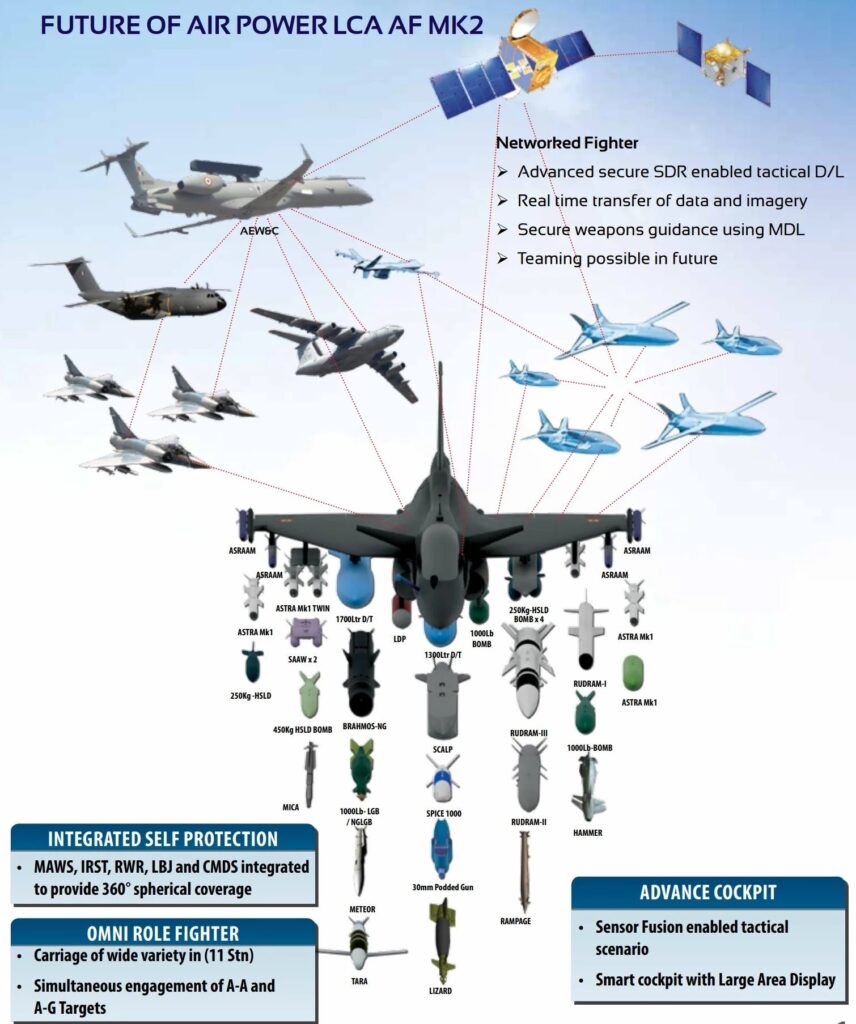
All onboard sensors will be highly integrated, with data from the AESA radar, IRST, MAWS and Electronic Warfare Suite fused to generate a single, comprehensive tactical picture. Instead of relying on multiple independent displays, this fused information will be presented to the pilot through a Wide Area Display (WAD), significantly transforming the cockpit architecture and improving the way the pilot interacts with the aircraft’s sensors and mission systems. With refinement, it will be used in the AMCA.
The Tejas Mk1A is a 4.5 generation aircraft but still operates on a federated avionics architecture, in which each subsystem (radar, EW suite, IRST, etc.) is a self-contained “black box” with its own processor and software. Communication between them happens over dedicated point-to-point or shared serial buses, not a common integrated network. Fusing data across sensors meant routing everything through separate boxes with different processors, data formats and timing, adding latency and making true “single picture” fusion very difficult.
Tejas Mk2 will come with Integrated Modular Avionics (IMA). Common processing modules host multiple sensor-processing tasks, so fusion algorithms can pull raw or lightly processed data from radar, EW, IRST and others on a common backplane, instead of waiting for each subsystem to finish its own local processing. IMA uses software partitioning (e.g. ARINC 653-style) so multiple functions of different criticality can run on shared processors safely, without one sensor’s software affecting another, which is critical for certification.
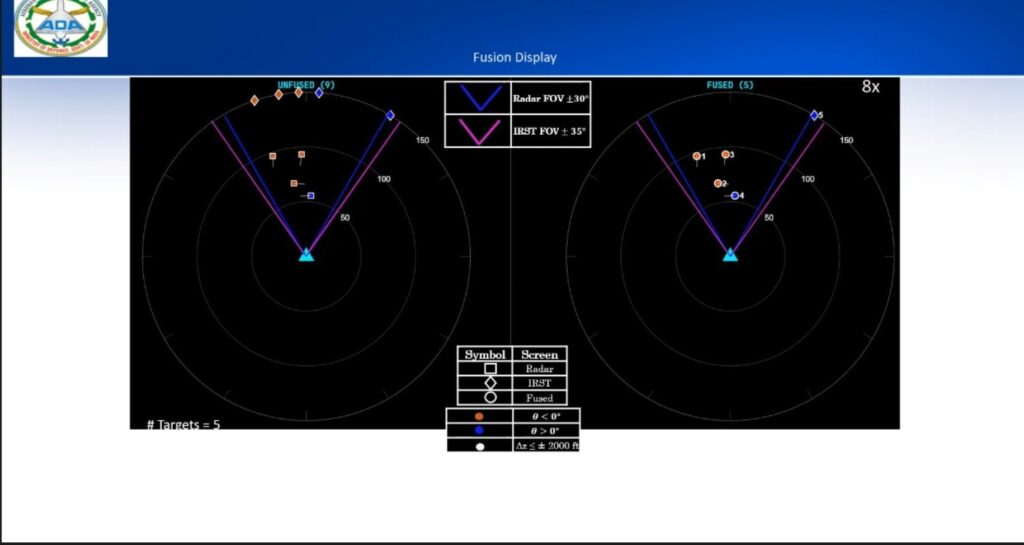
The sensor-fusion capability developed for Tejas Mk2 can provide an important foundation for AMCA’s future integrated sensor architecture. The significance lies not merely in transferring the Mk2’s software to AMCA, but in gaining practical experience in integrating and fusing data from multiple sensors such as the AESA radar, IRST, electronic warfare suite and MAWS. Engineers can develop and validate the algorithms required for track correlation, sensor registration, data synchronization and fused-track management, all proven in real flight conditions before they are refined for AMCA’s more demanding architecture.
The propulsion system provides another important area for technology maturation. Operating the F414 on Tejas Mk2 will provide engineers with extensive experience in integrating a higher-thrust-class engine with an indigenous fighter airframe under India’s operational and environmental conditions. This includes experience with engine control, inlet integration, thermal management, electrical power generation, accessory systems and overall airframe–engine interaction.
The development of indigenous engine accessories and systems, such as the Accessory Gearbox (AGB), further expands this knowledge base. Even where a future AMCA propulsion system differs from the Mk2’s engine, the engineering experience accumulated during Mk2 development and flight testing can help reduce integration risk in subsequent aircraft programs. Engineers will gather precise data on how the F414’s Full Authority Digital Engine Control (FADEC) manages fuel-to-air ratios in these extremes. The AMCA will inherit pre-optimized FADEC software maps, which helps shorten the testing phase and the design of FADEC software.
The Tejas Mk2 program has integrated advanced jig-less manufacturing and assembly techniques, marking a massive evolution in how India builds its indigenous combat aircraft. This transition solves major manufacturing bottlenecks seen in earlier iterations. Instead of assembling dozens of tiny metal parts using heavy fixtures, large single-piece structural components are carved out of solitary metal blocks using high-precision CNC machines. Because the parts fit together perfectly down to the micron, the requirement for massive alignment jigs is eliminated.
Tejas Mk2 also introduced monolithic machining, which plays a major role in weight reduction. Unlike the Tejas Mk1, which relied on multiple smaller pieces joined by heavy rivets, the Mk2 features large, continuous titanium frames carved from a single block of metal. This approach eliminates hundreds of fasteners and subcomponents, saving approximately 120 kilograms.
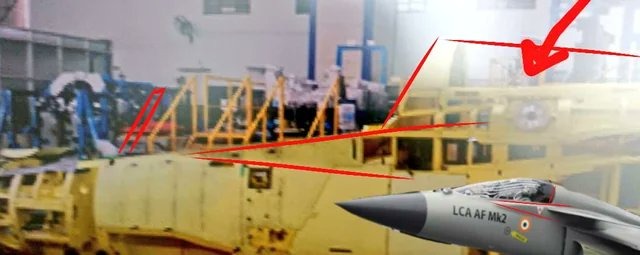
It also acts as a critical technological stepping stone for India’s 5th-generation stealth fighter. Because a 5th-generation aircraft requires an unprecedented level of structural precision, these advanced manufacturing methodologies are vital to making the AMCA program viable. They will reduce gaps, and monolithic machining carves large, complex sections (like the internal weapons bay frames or major wing-to-fuselage joints) out of a single metal block. Carving a single piece avoids seams, guarantees perfect surface flushness, and preserves the strict geometric tolerances required to keep the AMCA’s RCS very low and make it lighter.
Tejas Mk2 is expected to achieve a significant reduction in frontal radar cross-section (RCS), with its frontal RCS reported to be approximately one-quarter that of the Tejas Mk1. This represents a substantial improvement in signature reduction and reflects a greater emphasis on low-observable (LO) design.
This reduction is achieved through a combination of measures rather than a single technology, including optimized shaping, radar-absorbent materials (RAM), an FSS-based radome, treatment of leading-edge surfaces and improved management of structural gaps and joints. The advanced manufacturing techniques introduced with the Mk2 can further improve dimensional accuracy, surface continuity and consistency during assembly, helping maintain the intended electromagnetic characteristics of the airframe.
The importance of Tejas Mk2’s low-observable development extends beyond the reduction in its own radar signature. It provides Indian designers and industry with practical experience in LO shaping, materials, antenna integration, manufacturing tolerances, surface quality and RCS validation. These capabilities can form an important technological foundation for AMCA, allowing India to approach fifth-generation stealth design with tested processes and experienced teams rather than starting from scratch.
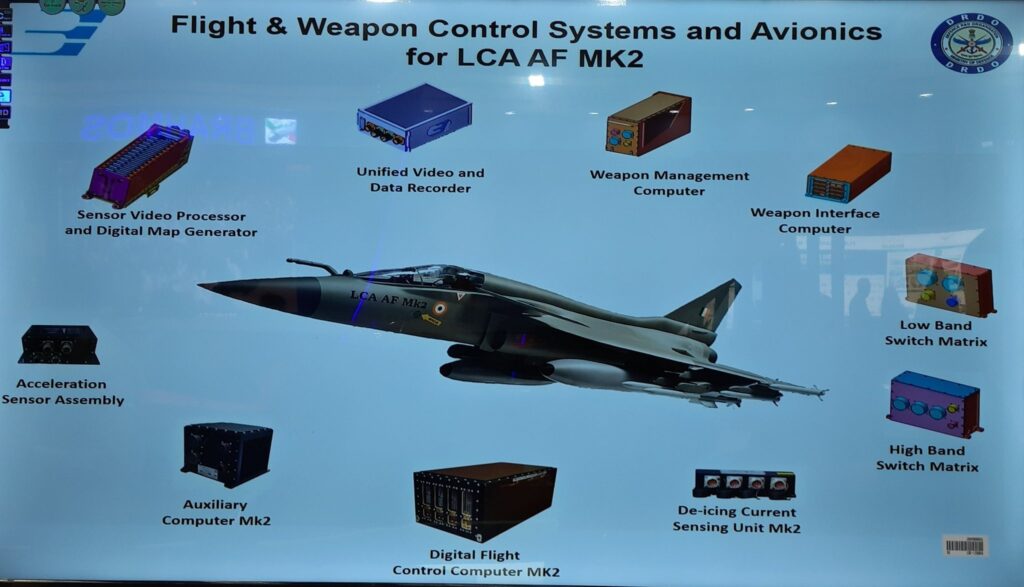
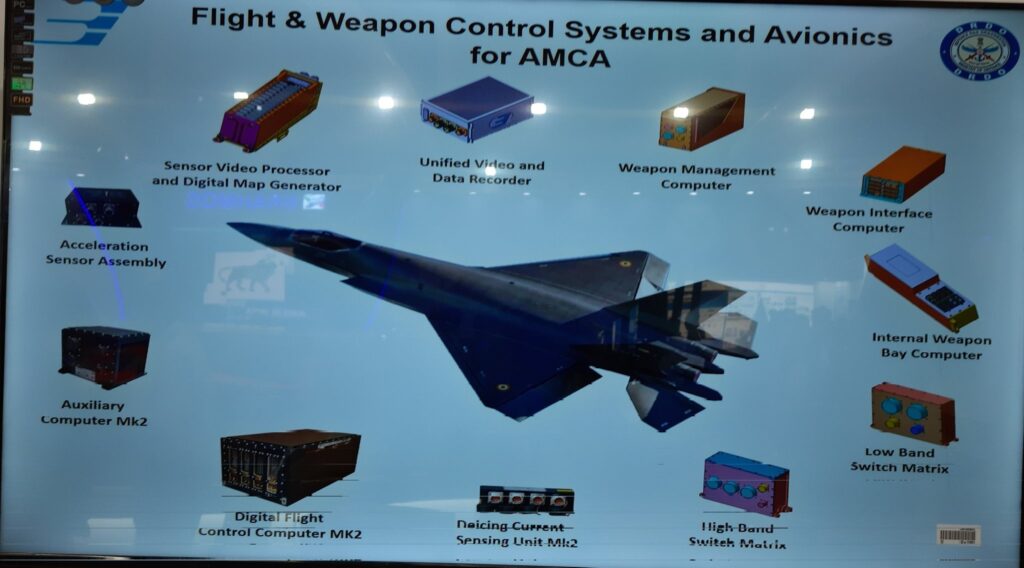
The Tejas Mk2 and AMCA share a common foundation in their Flight & Weapon Control Systems and avionics, as indicated by the DRDO displays. Several systems, including the Digital Flight Control Computer, Auxiliary Computer, Sensor Video Processor & Digital Map Generator, Unified Video and Data Recorder, Weapon Management Computer, Weapon Interface Computer, and high/low-band switch matrices, are shown for both aircraft. This commonality allows technologies and software developed and validated on Tejas Mk2 to be matured through flight testing before being carried forward and further refined for AMCA, thereby reducing development and integration risk.
Tejas Mk2 is far more than an upgrade over the Mk1A. It is the proving ground where India will validate, in actual flight, the technologies its fifth-generation fighter depends on: GaN-based AESA radar and IRST, integrated modular avionics with true sensor fusion, F414 engine integration and FADEC maturity, jig-less and monolithic manufacturing, and low-observable design. Each lesson learned on the Mk2 reduces development risk, shortens testing timelines and builds industrial confidence for the AMCA. For the IAF, the Mk2 is a capable 4.5+ generation workhorse today. For India’s aerospace ecosystem, it is the bridge to a stealth future.