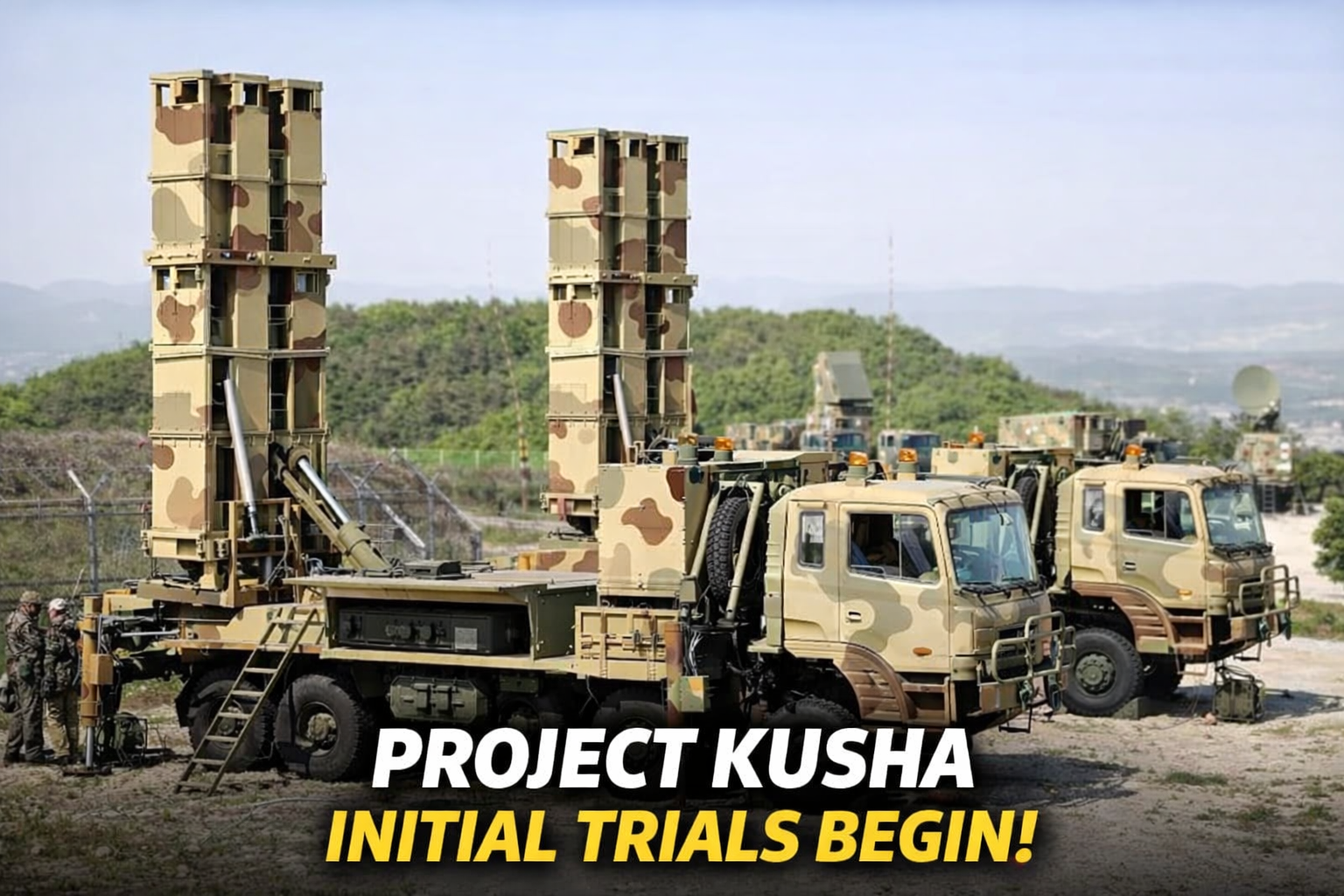
India’s long-awaited Project Kusha, officially known as the Extended Range Air Defence System (ERADS), appears to have crossed a critical milestone. Defence Secretary RK Singh has confirmed that initial trials of Project Kusha have been successfully conducted, marking the programme’s transition from design and development into early validation.
Interestingly, just a couple of weeks earlier, officials from DRDO’s Defence Research and Development Laboratory (DRDL) had stated that preparations were underway for the maiden trials of the missile. If both statements are taken at face value, it is reasonable to assess that at least one test may have taken place recently without public disclosure ~ a practice not unusual for sensitive air defence programmes.
This quiet progress underscores the strategic importance of Project Kusha for India’s future air and missile defence architecture.
What Is Project Kusha (ERADS)?
Project Kusha is a next-generation, long-range air defence programme being developed by the Defence Research and Development Organisation (DRDO) for both the Indian Air Force (IAF) and the Indian Navy. Earlier referred to as XRSAM (Extended Range Surface-to-Air Missile), the system is designed to bridge the capability gap between MR-SAM systems and strategic-level missile defence assets.
Once operational, Project Kusha is expected to form the backbone of India’s indigenous alternative to imported long-range air defence systems, while being tightly integrated into India’s evolving Integrated Air Command and Control System (IACCS).
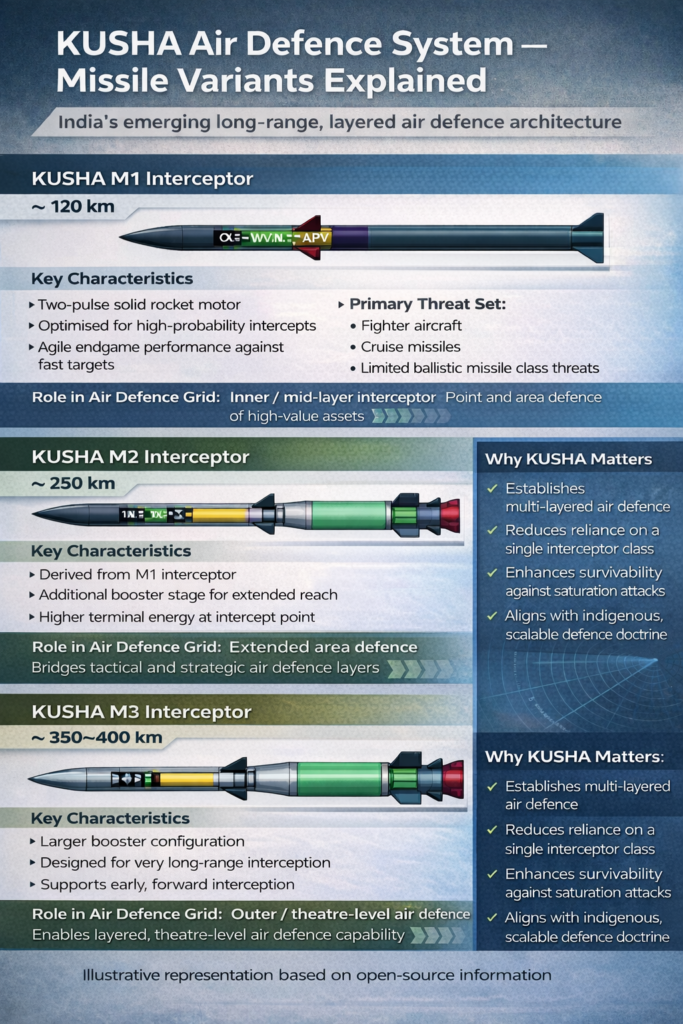
Three-Interceptor Architecture: M1, M2 and M3
Project Kusha is structured around three interceptor variants, each designed to address a specific engagement envelope:
🔹 M1 Variant – ~120 km Range
- Two-pulse solid rocket motor
- Designed for high-probability intercepts against fast aerial targets
- Likely optimised for aircraft, cruise missiles, and limited ballistic targets
🔹 M2 Variant – ~250 km Range
- Based on the M1 interceptor with an additional booster stage
- Extended engagement range and higher terminal energy
- Intended to counter high-value airborne assets and longer-range threats
🔹 M3 Variant – 350–400 km Range
- Uses a larger booster configuration
- Designed for very long-range interception
- Brings India closer to a layered, theatre-level air defence capability
Together, these three variants allow Project Kusha to cover engagement ranges up to 350–400 km, offering flexibility across multiple threat scenarios.
Technology Maturity: DRDO’s Advantage Going In
One of the reasons Project Kusha has progressed relatively quickly on paper is that DRDO is not starting from scratch.
Dual-Pulse Solid Rocket Motor Expertise
- DRDO has already mastered dual-pulse solid motor technology
- This capability has been validated through Akash NG
- Energy management, re-ignition timing, and terminal manoeuvrability are now well understood
From a conceptual standpoint, a scaled-up Akash NG architecture could comfortably evolve into the M1 interceptor, with M2 and M3 emerging through booster augmentation.
Why Project Kusha Is Not “Just a Bigger Akash”
While Akash NG provides a strong technological foundation, Project Kusha aims for a different performance regime altogether.
To achieve:
- Longer ranges
- Higher sustained speeds
- Greater end-game energy at extended distances
…the missile’s solid propellant grain composition is likely to be significantly different. Higher energy propellants, revised burn profiles, and thermal management solutions will be essential to meet ERADS requirements.
In other words, Project Kusha is evolutionary in philosophy, but revolutionary in scale and performance.
Strategic Significance for India
Once inducted, Project Kusha will:
- Strengthen India’s multi-layered air defence shield
- Reduce reliance on foreign long-range SAM systems
- Offer a common air defence solution for both the IAF and Indian Navy
- Enable better protection against stand-off weapons, high-speed threats, and force multipliers
The system also aligns with India’s broader push toward strategic autonomy and indigenous air defence manufacturing.
A Programme Advancing Quietly—By Design
The absence of public visuals or press releases around recent trials should not be misread as stagnation. For programmes of this sensitivity, controlled disclosure is often a deliberate choice.
With initial trials now confirmed at the highest bureaucratic level, Project Kusha has clearly entered a new phase.
The coming months will reveal more about India’s most ambitious indigenous air defence programme.
we never knew Akashteer existed before Sindhur.