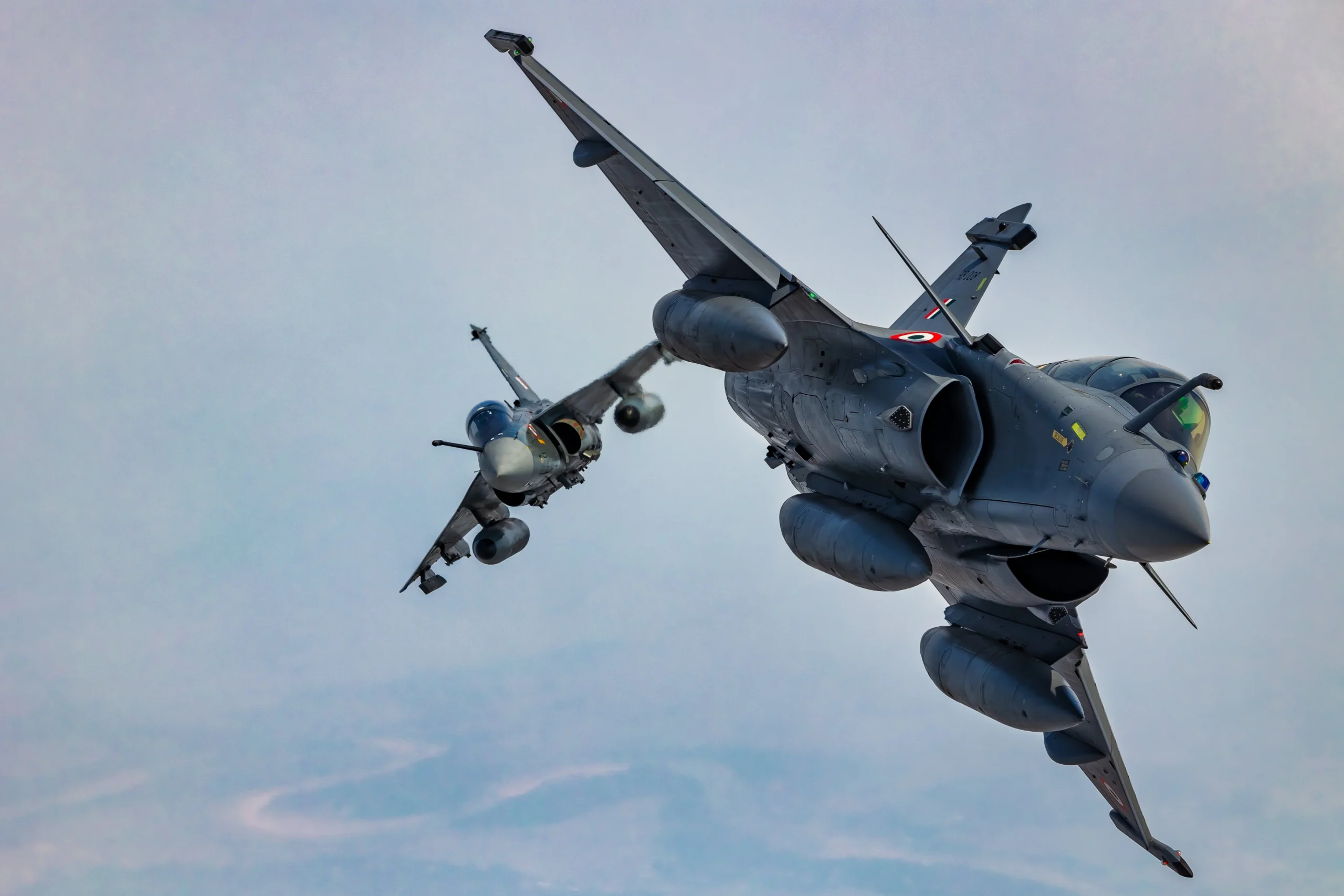
India’s fighter aircraft debate today is less about comparing two platforms and more about two mindsets that have taken shape around them.
On one side is a broadly pro-Rafale set. On the other, a pro-Tejas set. These are not just fan groups for different aircraft categories; they represent deeper arguments about IAF capability, industrial capacity, and how India should build air power in the long run.
The pro-Tejas set has consistently argued that India must develop and field its own aircraft, weapons, and subsystems, not because imports are useless, but because imports do not automatically solve sovereignty, availability, or integration challenges. As part of that argument, they repeatedly pointed out that IAF’s Rafales operated for years without full India-Specific Enhancements, including ISE and other customised elements. This was not a misunderstanding or misinformation; it was a known, documented reality.
For a long time, that argument was dismissed or minimised. Now, interestingly, several pro-Rafale voices are quietly acknowledging the same facts. Reports related to Meteor integration issues are in the public domain. It is also increasingly accepted that certain components such as X-Guard are still not available in the Indian configuration. The takeaway is not that Rafale is inadequate, but that importing an aircraft does not magically deliver a fully sovereign, fully customised combat system on day one.
And that point matters, because the debate was never about Rafale versus Tejas as equals. It has always been about what actually builds IAF capability and what realistically expands Indian manufacturing capacity.
However, this is where inconsistency creeps in when Rafale was inducted with pending India-specific enhancements, the argument was that capability available today matters more than configuration completeness, and that custom systems can mature in parallel. That standard was broadly accepted. Also, the purchase was just token 36 units.
But when the same logic is applied to the LCA Tejas Mk1A, the conversation flips.
Today, the manufacturers argue that missiles have been fired, the aircraft is safe, and remaining technical issues can be addressed post-delivery. The Indian Air Force, however, has dug its heels in, stating clearly that it will not accept aircraft until all contracted systems are integrated. Some then ask “reasonably” why this yardstick was not applied as firmly in the Rafale case.
This is not a trivial question, and it deserves a serious answer, not narrative management. To understand why the Mk1A case is different, one must go back to program structure.
LCA Mk1 was the refinement phase. That was where design instability, flight control learning, manufacturing immaturity, and first-time integration risks were expected and largely absorbed.
Mk1A is the consolidation phase.
It is not a technology demonstrator. It is not an experimental batch. It is meant to lock configuration, stabilise production, and deliver what has already been promised, at scale.
With an order book moving toward 180 aircraft, Mk1A cannot function on shifting benchmarks. When timelines for core systems keep moving from one batch to the next, and now to future lots, the concern is not about ambition. It is about credibility and execution.
When the makers initially committed to integrating Uttam from the 21st aircraft, the timeline kept slipping to the 41st unit, then the 61st, and now the 84th unit, which is the first aircraft of Lot 2. Uttam radar and the Swayam Raksha Kavach (SRK) represent clear capability upgrades over what the LCA currently operates. This repeated deferral exposes a flawed tactical mindset: prioritising assembled subsystems of Israeli origin simply because they are integrated and delivered by HAL, even when superior indigenous systems are available. Such decisions hurt HAL itself in the long run, as they reveal a focus driven more by organisational convenience and legacy assembly lines than by the genuine operational and technological interests of the LCA programme.
At the same time, the pro-Tejas set is not blind to reality either. Indigenous development is messy. Government approval cycles are slow. Outside suppliers take years to clear. Interface control, certification authority delays, and inter-agency coordination frequently hold up integration. These are structural problems, not excuses.
But acknowledging those problems does not mean lowering standards especially at the consolidation stage.
The honest position, therefore, is not to defend Rafale uncritically or shield Tejas indefinitely. It is to apply consistent logic.
If incomplete India-specific enhancements were acceptable during Rafale induction, that fact should be openly owned.
If Mk1A is positioned as a fully loaded, production-standard aircraft, then it must be delivered as promised, not explained into acceptability.
India does not win by importing aircraft without sovereignty, nor by inducting indigenous platforms before they are ready for scale. The IAF needs capability it can rely on, and the ecosystem needs manufacturers who deliver what they contractually commit to not what markets applaud.


Agree with the reasoning 200%. Great article !