~ Space Walker
India can now design its own torpedoes, mines, sonars and fuel-cell submarine power. It still takes about ten years to get a finished weapon from the lab to the sailor. The next 14 months will show whether that gap starts to close.
A torpedo India designed, a tube France built
If the schedule holds, a Kalvari-class submarine will leave Mumbai in the coming weeks and fire an Indian torpedo. The weapon is Takshak. Its harbour validation is done, user trials from a Kalvari boat are planned for late 2026, and a live-warhead shot is expected in 2027. Clear both and India will have fired an indigenous heavyweight from a French submarine’s tube.
The trials carry extra weight because of what happened on 14 December 2017, when INS Kalvari was commissioned. She is a Scorpene with six 533 mm tubes and a French combat system, and her weapon spaces were drawn around the Italian Black Shark, which India selected years earlier and never bought. Its successor, the Black Shark Advanced, was contracted only on 30 December 2025: 48 rounds for about ₹1,900 crore, will be delivered from April 2028 into early 2030. That is about ten years between a submarine going to sea and her designed primary weapon reaching the quay.
Two stories get told about this. In one, India now builds its own torpedoes, mines and sonars, which is true. In the other, the Navy’s best boats sailed under-armed for a decade, which is also true. Both describe the same country on the same afternoon. The useful question is why the gap between what India can build and what it can field has stayed so wide.
The ocean is the first opponent
Radio waves do not travel through seawater and light dies within a few metres. Over the tens or hundreds of kilometres that matter in a naval fight, only sound carries. It moves at about 1,500 metres a second, but the speed shifts with temperature, salinity and pressure, and wherever it shifts, sound bends.
Take the northern Arabian Sea in May. A warm surface layer sits on much colder water, and sound entering that gradient bends downward until rising pressure bends it back up. Between the two paths lies a shadow zone, often close to your ship, that a hull sonar cannot see into. A diesel boat loitering under the layer needs no clever engineering to hide there. Refraction does it for free.
That layer explains a lot of Indian hardware. NPOL’s history starts with expendable bathythermographs, throwaway probes that measure the temperature profile and show where the layer sits. Without that reading, a hull array is an expensive guess. The same problem is why the new shallow-water corvettes carry a variable-depth sonar that goes down through the layer, and why HUMSA-NG now has a bathythermograph built into the operator console.
Sound also fades as it travels, and absorption rises roughly with the square of frequency. A search sonar that wants long range must work at low frequency, which needs a large array and so a large ship. A torpedo seeker has to fit inside a 324 mm nose and only needs to see the last two or three kilometres, so it runs at high frequency and is nearly blind until it is almost on the target. Nobody chose that trade. The water imposes it. It makes a lightweight torpedo a short-sighted weapon that something else must deliver accurately, and it makes a 643 km anti-submarine missile far harder than it looks.
The sonar equation sums it up. Signal excess is source level, minus twice the transmission loss, plus target strength, minus the noise you cannot remove, minus the threshold your processor needs to call a contact. Anechoic tiles attack target strength, quieting attacks the passive side, and every processing upgrade out of Kochi tries to push the threshold down. It is a contest fought in decibels, over very small margins.
Three labs, one late test facility
India’s undersea systems sit in three DRDO laboratories with a clean division of labour. NSTL at Visakhapatnam, set up on 20 August 1969, handles the things that move: torpedoes, mines, launchers, hydrodynamics and autonomous vehicles. NPOL at Kochi handles the things that listen. NMRL at Ambernath handles materials and, increasingly, the fuel-cell plant that lets a conventional submarine stay down for about two weeks.
One detail about NSTL explains Indian torpedo timelines better than any procurement chart. As I understand it, the facilities to design a torpedo end to end, the high-speed towing tank, the variable-pressure cavitation tunnel and the acoustic and shock labs, arrived around 2013, more than four decades after the lab opened. For years Shyena, Varunastra and Shakti were validated partly on someone else’s equipment, which adds lead time and shows the host what you are building. The gap is being closed in public: on 3 April 2026 the Defence Minister laid the foundation stone for a Large Cavitation Tunnel at NSTL and said critical testing had too often been done abroad.
Industry is catching up on the same pattern. BDL’s underwater weapons unit sits deliberately next to NSTL and Eastern Naval Command, so designer, maker and customer are within driving distance. On 15 May 2026 the Raksha Mantri laid the foundation for a much larger naval systems plant at T. Sirasapalli in Anakapalli district: about ₹500 crore, roughly 160 acres, four years to build and about 3,000 jobs promised. Whether the plant and the jobs both arrive on schedule is for the next four years to answer.
Around the public sector a supply chain has formed. BEL builds the NPOL-designed sonars and the Maareech countermeasure suite. Apollo Micro Systems in Hyderabad makes mine and torpedo electronics, power units and fuzing, and is working on software-defined homing heads. L&T supplies shipborne launchers and the AIP energy modules. GRSE, CSL and MDL build the platforms that carry all of it. None of this existed in this form in 2005.
Torpedoes: one proven, one rising, one still waiting
Shyena, the lightweight that proved the line
TAL Shyena is India’s first indigenous torpedo: 324 mm, about 220 kg, 33 knots and six minutes of electric endurance, launched from ships and helicopters. It reached the Navy on 3 March 2012 after 24 firings between 1998 and 2000, and it became India’s first torpedo export when Myanmar signed for about $38 million in 2017. The air-drop was the hard part, surviving the jump from air to water, and it is why parachute and release work at ADRDE Agra and NSTL matters.
At 33 knots a torpedo covers about a kilometre a minute, so six minutes buys about 6 km at full speed. That is not a weakness. A lightweight exists to finish a close fight. Yet 7, 19 and 20 km all appear as Shyena’s range, and the warhead is quoted at 40 kg in one place and 50 kg in another. I see three honest reconciliations: the six minutes is sprint endurance and the longer figures are slower search profiles, a later battery variant exists, or the larger numbers add the parachute descent and search to the run. Whichever it is, setting it beside the Mk 54’s 9 km in a table compares nothing.
The successor, the ALWT, is under-reported. NSTL’s new 324 mm weapon is said to run at about 47 knots, roughly 40 per cent faster, with a pumpjet in place of contra-rotating screws and a digital broadband homing head. Lithium-ion packs are reportedly in trial, and if they mature they change the arithmetic for every Indian electric torpedo, because silver chemistry is the constraint on all of them. On the American side, the Mk 54 is deliberately plain engineering, and its value is a processor that can pull a hull echo out of bottom-bounce clutter in shallow water, which is the Bay of Bengal problem. Washington cleared 53 more rounds for India’s MH-60R helicopters in October 2024, about $175 million, on top of existing stock. That matters because air ASW burns through lightweights and many drops land on whales.
Varunastra, the biggest win and its lesson
Spec sheets for Varunastra disagree. BDL’s page gives 7.78 m, 533 mm, about 1.6 tonnes for the practice round and 1.85 tonnes combat, selectable speeds of 27 to 40 knots and a depth of 8 to 600 m. DRDO’s export compendium says about 1.9 tonnes, 40 knots, 500 m and a 250 kW contra-rotating motor on a zinc-silver oxide battery. A third cluster rounds the mass to 1.5 tonnes, pushes speed to 50 knots and quotes 40 to 50 km of range as if stamped on the casing. My read: treat 40 knots as the certified speed, treat 500 and 600 m as one envelope quoted twice, and treat range as a derived number, because that is what it is.
The arithmetic shows why. A 250 kW motor running 15 minutes uses about 62.5 kWh. At 120 Wh/kg, silver-oxide-zinc needs roughly 520 kg of cells, which a 1.9-tonne weapon can hold. So the 40-knot figure and the 50 km figure describe different runs. Both can be true of the same weapon.
Follow one engagement and most of the design explains itself. The ship’s combat system builds a solution from the hull sonar or towed array and loads waypoints before launch. A twin-tube L&T launcher throws the weapon clear on high-pressure air. On entry a pyrotechnic actuator floods the battery with electrolyte and it reaches full voltage within seconds. Direct drive removes the gearbox, a major noise source, and contra-rotating screws cancel torque and recover swirl energy for a quieter signature. In mid-course a fibre-optic wire pays out from both ship and torpedo, so the ship keeps feeding its sonar picture forward, the operator can steer around a thermocline and the shot can be aborted. If the wire parts, the weapon finishes on its own algorithms. The terminal seeker is a conformal array wrapped around the nose, which widens the look angle against a target manoeuvring hard in the last 30 seconds. Varunastra is often described as the only torpedo with a GPS aid, which officially helps recover exercise rounds and align the weapon during its surface run.
Underneath it sits Apollo Micro Systems, which reportedly got an order from BDL in 2024 for a software-defined homing system for heavyweights, worth only about ₹11 crore. Apollo says it is the sole qualified design and is being adapted for lightweights. If that holds, India gets one upgradable seeker baseline across Varunastra, the ALWT and Takshak. When an opponent’s decoys improve, you ship a new classifier instead of building a new torpedo. It gets little praise, but I would rank it among the most consequential items here, and it costs less than a single round.
The timeline is where the mood changes. Development began around 2005, and NSTL said in 2008 the weapon would enter service in 2009. User trials ran in early 2015 and the first unit was inducted in June 2016. Technology went to BDL in April 2018, the contract for 63 units, about ₹1,190 crore at roughly 95 per cent indigenous content, followed in June 2019, and the first serial round left the factory on 21 November 2020. The first live-warhead firing, from a corvette at a submerged target, took place on 5 June 2023 and was announced two days later, seven years after induction. Live warshots are expensive and no navy fires them casually, so that alone is no scandal. A follow-on order of about ₹1,500 crore is reported, and it buys magazine depth where the first order mostly bought an induction. In late April 2026 BDL also delivered production-grade rounds of the wire-guided heavyweight to NSTL, which most coverage reads as the productionised line growing out of Varunastra and Takshak.
Takshak and the question of who owns the interface
Takshak is the electric heavyweight sized for the Scorpene: about 6.4 m long and 533 mm across, on silver-oxide batteries, with a ring-laser-gyro inertial unit backed by GPS and NavIC and fibre-optic wire guidance. Reported figures put the battery near 300 kW, the warhead near 300 kg, range near 40 km and depth near 400 m. At 6.4 m against Varunastra’s 7.8 m, its basic dimensions were set by French tubes.
Its launch method is the interesting part. Takshak swims out: the tube floods, the door opens and the torpedo drives itself clear on low-RPM motor power instead of being blown out by compressed air. That air pulse is a loud, sharp event, and an enemy’s passive sonar can take a bearing on the firing submarine from it almost at once. A submarine is worth something only while nobody can locate her, so deleting that bang buys a great deal of survivability.
Shakti, three decades on
NSTL proposed Shakti in 1995: a thermal heavyweight burning Otto fuel to drive a pumpjet. On physics the case is strong. Combustion stores far more energy per kilogram than a battery, which is why the Mk 48 and China’s Yu-6 run at 55 to 65 knots while electric torpedoes sit around 50. The costs are known too: exhaust must vent against the sea and back-pressure at depth eats efficiency, combustion is loud, and Otto fuel breaks down into products that need their own handling regime. A CAG audit in 2014 reportedly recorded three torpedoes lost in sea trials and about ₹71 crore spent, and found that the absence of a firm qualitative requirement at the outset had damaged completion.
Thirty years in, the useful question is where the decision gate sits. Either fund a focused fix for the engine and depth compensation against a hard deadline, or close Shakti and move the money to lithium-ion. Another decade of indecision is not patience. It is the absence of a strategy. The supercavitating torpedo on NSTL’s foresight lists deserves the same caution: the physics is understood, but guidance is the hard part, because you cannot hear through your own bubble.
Black Shark: a procurement failure, not a technology one
In the 2000s the Black Shark was chosen as the Scorpene’s weapon, with about 98 rounds planned. WASS beat Atlas Elektronik, and by the early 2010s it was the lowest bidder at roughly ₹1,500 to 1,800 crore, depending on the source. Then the AgustaWestland helicopter case produced bribery allegations, and in 2014 the Defence Ministry suspended dealings with Finmeccanica and its affiliates, WASS among them. The selection was formally cancelled in 2016. The blacklisting answered a real corruption investigation, and a state that never punishes vendors gets the vendors it deserves. But the cost landed on the Navy, because the Kalvari class was already in build around that specific weapon, and any other torpedo meant modifying the tubes and the fire-control interfaces behind them.
So Kalvari commissioned without a modern heavyweight. The stopgap was the older German SUT, a wire-guided electric round that came with the Type 209 boats in the 1980s and had to be re-engineered into the French combat system. The Kilo class’s Russian torpedoes do not fit a Scorpene tube in any sense that matters. A fresh tender for 100 heavyweights went out in 2019, the Leonardo ban was lifted in November 2021, and through 2024 to 2025 the French F21 stayed compliant but dearer while Italy bid hard and dangled Indian manufacture later.
The deal was signed on 30 December 2025 for about ₹1,900 crore, more than 200 million euros: 48 Black Shark Advanced rounds with launch network, maintenance gear and spares, built at Livorno, delivered from April 2028 to early 2030. Fincantieri called it the largest order in WASS history. WASS says it is open to Make in India later, but this contract is a straight purchase from abroad.
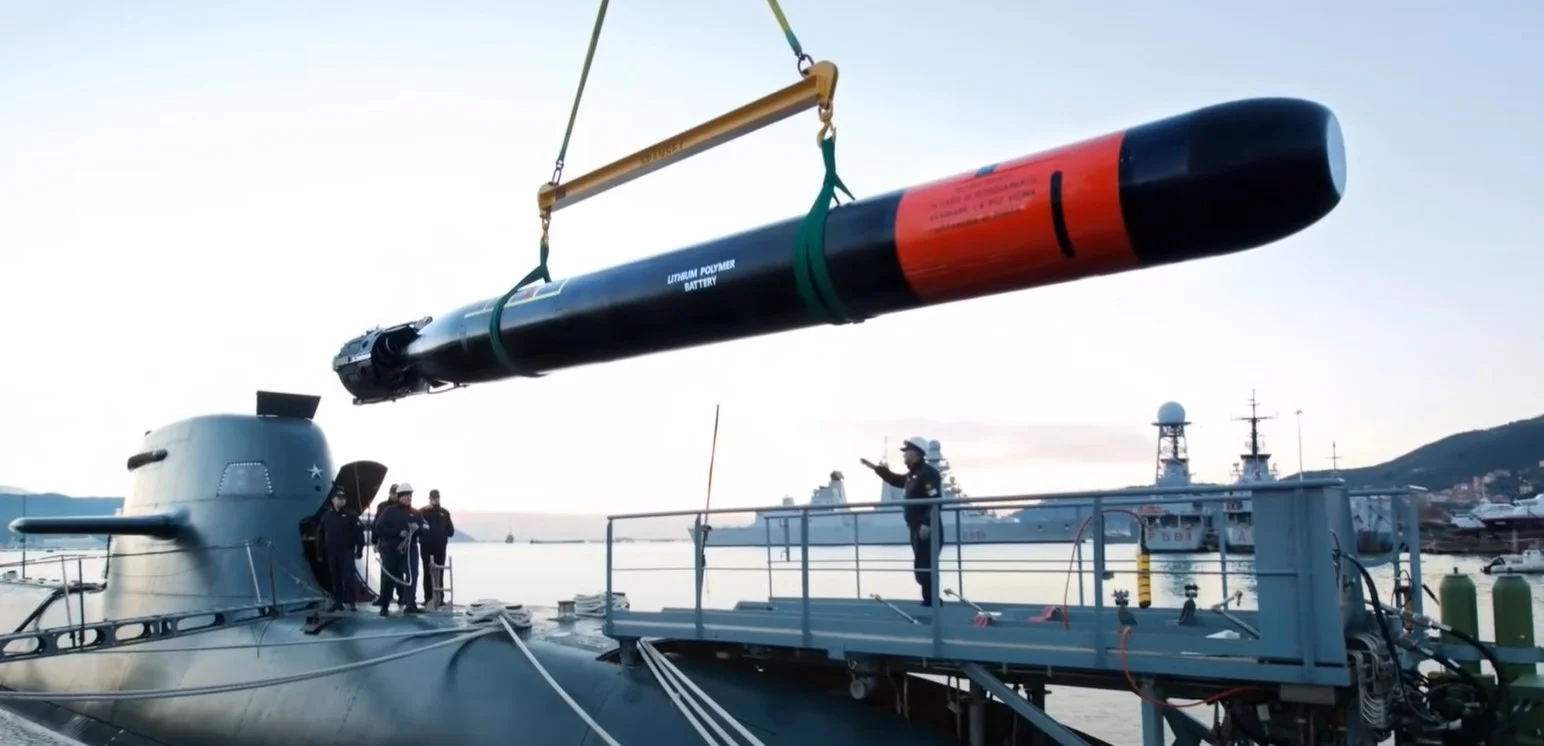
The weapon is excellent, which makes the delay worse. It carries a 350 kg insensitive-munition warhead at more than 50 knots out to the 50 km class, and its digital seeker can double as a remote sensor feeding the submarine’s own combat suite. A contra-rotating brushless motor starts at low RPM, so the launch is clean. The Advanced upgrade is mostly the battery: rechargeable lithium-polymer in place of aluminium-silver oxide. Which chemistry India’s combat rounds use is not clear in open sources, and I will not guess.
Where the India-first lens matters
Takshak is the answer to the question this saga raised, and it brings the same question back in a new form. On 30 December 2024 the Ministry paid Naval Group about ₹877 crore to integrate Takshak’s guidance software and firing logic into the French-owned combat system on India’s own Kalvari boats. That is the price of letting an Indian weapon talk to a submarine India built under licence. The weapon is Indian. The interface is not. Whoever owns the interface sets the integration schedule and the integration price, and that is design authority, which is exactly what India should refuse to rent out on the next submarine contract. If Takshak’s trials go well, DRDO is positioned to own the follow-on order for the whole Kalvari fleet, which would turn a stopgap import into a home-built weapon line.
Fifty years of listening
Sonar is the success story, and it began with a programme whose importance was industrial first. APSOH, a late-1970s NPOL project, mattered less for its performance than for the fact that NPOL carried hull-sonar electronics from laboratory breadboard all the way to production at BEL. That opened the door to total indigenisation of ship sonars, and everything since descends from it. HUMSA followed for the 1990s frigates, HUMSA-UG shrank the hardware behind the same array, and HUMSA-NG added lower-frequency transducers, simultaneous active and passive operation and tracking of several targets across Project 17, 15A and 28 hulls.
The newest version, HUMSA-NG Mk II or HUMSA-2020, is the one on INS Dunagiri, commissioned at Kolkata on 21 June 2026. It is described as having active detection to about 40 km, adaptive beamforming, automated torpedo alerting and an expendable bathythermograph built into the console. That last detail interests me most, because it means the operator measures the layer before deciding how to search. INS Agray, commissioned the same day, carries the Abhay sonar, built to separate a submarine echo from bottom bounce in shallow, reverberant water. Putting a real ASW sensor on a small coastal craft is no small thing.
Below the ship the story is less flattering. Nagan was India’s own towed array, a low-frequency projector with a long passive line meant to put the receiver under the thermocline, where the submarines are. It stalled, and in November 2014 the Ministry bought six Atlas ACTAS systems for about €40 million for Talwar, Trishul and Tabar and for Delhi, Mumbai and Mysore. That purchase is why those six hulls can fight under the layer and a HUMSA-only ship cannot, and arguably it was the most important sonar decision of the last 15 years. It was an import. The Arnala class repeats the pattern: its variable-depth sonar comes from CFF Fluid Control with Atlas Elektronik, so on a ship that is largely indigenous, the foreign content sits in the winch, the handling gear and the towed body. That is the conspicuous hole, and closing it is the next test of the sonar line.
Submarine suites tell a different story. A boat works passive first, because going active announces you. The USHUS family combines passive cylindrical and active arrays with an intercept receiver meant to hear the other side’s ping before they hear your echo, and BEL productionised NPOL’s design for the Kilo class. Its delays drew audit criticism a decade ago, and USHUS-2 has been delivered since 2017.
Maareech deserves better than the “decoy” label. NPOL led it with NSTL, BEL productionised it, and it pairs a towed array and hull-mounted intercept sonar that detect an incoming torpedo with onboard electronics that localise it, compute its approach and recommend an evasion course. A towed decoy then sounds like a larger, more attractive target, and the seeker spends its battery chasing nothing. The ship never has to kill the torpedo. Wasting it is enough. Two production systems entered service on 14 November 2015 for about ₹59 crore, formal induction followed on 26 June 2020, and BEL can now build about a dozen a year. The Kalvari boats reportedly still rely on an imported anti-torpedo suite, and I see no public date for an Indian one.
The cueing layer, and the 643 km question
The weakest layer in the whole architecture is wide-area cueing. NPOL has an indigenous airborne line: the TADPOLE sonobuoy, the SIMHIKA processor, the MIHIR dipping sonar for the ALH Mk III and Sea King, and a newer low-frequency dunking sonar. The consequential development, though, is a co-production deal. In August 2024 the US cleared about $53 million of passive, active and bathythermal sonobuoys for India, reportedly around 500 units. BDL and Ultra Maritime signed a production-planning contract at Aero India in February 2025, and production starts at BDL Visakhapatnam in 2027, with buoys that work across the P-8I, MH-60R and MQ-9B.
If that line starts on time and is then funded to a genuine wartime reserve rather than a peacetime training allowance, it will add more capability than any torpedo in this article. Multistatic fields are how you find a quiet AIP boat in warm water: one buoy pings, several listen, and the mathematics does the work. The platforms are in reasonable shape, with 12 P-8Is, a growing MH-60R fleet and a lease signed on 17 August 2026 for two more MQ-9B Sea Guardians, about ₹1,940 crore for 30 months, bridging until the 31 aircraft contracted in October 2024 arrive. A periscope is a hard radar target, though: a cross-section of a fraction of a square metre, up for seconds, in sea clutter. Detection stays probabilistic, and gets worse as the sea gets rough.
SMART depends on that layer completely. It is a canister-launched two-stage solid missile that flies at Mach 2.5 out to 643 km on a two-way datalink and releases a lightweight torpedo, with Shyena as the test payload and the ALWT intended later. The torpedo has a 20 km run and a 50 kg warhead. Over the datum the nose cone separates and a parachute system from ADRDE Agra kills the residual speed so the torpedo does not pancake on entry. DRDL and RCI build the missile, NSTL the underwater end. Flight tests began on 5 October 2020 at Wheeler Island, and the most recent known firing, from Kalam Island on 1 May 2024, was counted as the third public test by Jane’s and the fifth by other tallies. Getting a 220 kg torpedo off a supersonic missile symmetrically and into the water intact is hard, and the team has now done it repeatedly. The engineering is genuinely good.
The doubts concern everything around the missile. Two retired officers cited in a July 2026 analysis argue that long-range ASW works only with real-time wide-area surveillance, meaning sonobuoy fields laid by patrol aircraft and watched by unmanned systems, and that every minute of delay lets the submarine become somewhere else. The numbers are unforgiving. A nuclear submarine at 30 knots covers a nautical mile every two minutes. A 600 km flight at Mach 2.5 takes about 13 to 15 minutes, in which time the target’s position uncertainty grows into a circle 15 to 20 nautical miles across, while a torpedo’s terminal acquisition radius is far smaller. Induction is discussed for around 2031.
So SMART is best understood as the last third of a weapon whose first two thirds are an aircraft, a sonobuoy field and a datalink that survives jamming. Its value depends on an architecture India is building but does not yet have at density. Peer systems, such as the US VL-ASROC at about 22 km, are deliberately short-ranged, perhaps because their designers concluded the cueing would never support a long-range ASW taxi. India is betting the cueing arrives. Time will tell.
At the other end of the range scale, ERASR is unglamorous and useful. It fills the gap between the old Russian RBU-6000 rockets, at about 5.5 km, and everything longer, with a short trajectory out to about 2.7 km and an extended one to about 8.9 km, and it swaps a Russian dependency for an Indian product. Sea firings from INS Chennai began in April 2023, and user evaluation on INS Kavaratti in 2025 reportedly met every objective.
Mines, and the hole where the sweepers should be
The multi-influence ground mine, MIGM, is the best value for money in this inventory. NSTL developed it with HEMRL on energetics and TBRL on terminal ballistics, and BDL Visakhapatnam and Apollo Micro Systems produce it. Its job is to replace the old Russian mine stocks.
The idea is simple. A single-influence mine fires on one cue, so one tool can sweep it. A multi-influence mine correlates several. Broadband hydrophones listen for machinery and blade noise, magnetometers watch the field distortion a steel hull drags behind it, and pressure sensors catch the drop as a hull pushes past or above. An ARM-class processor sits dormant on microamps, wakes when a threshold trips and checks the channels against a threat library. That fusion lets the mine ignore sweep gear and noisemakers and fire at the closest point of approach, where the bubble pulse works under the keel. A shock wave dents a ship. A collapsing bubble jetting beneath her breaks the girder. A stealth warship, for all her anechoic tiles, still has a pressure wave and a magnetic moment.
On 5 May 2025 the Navy and DRDO conducted a combat validation firing with reduced charge, and the DRDO chairman said the mine was ready for induction. India learned what mines do to an enemy’s sea lines early: in 1971 the Navy mined the approaches to Chalna and the Pussur river to cut merchant resupply into East Pakistan.
And yet India has no dedicated minesweepers. The last of the old Soviet-built Pondicherry class left service by 2019. The Navy has wanted a replacement force since the mid-2000s, and the Goa Shipyard programme with South Korea’s Kangnam, worth about ₹32,000 crore, collapsed in January 2018 over transfer of technology and cost. The Defence Acquisition Council gave approval to proceed for 12 indigenous mine countermeasure vessels, at about ₹44,000 crore, on 3 July 2025. A formal tender is still awaited, an internal assessment reportedly puts the real need at 24 hulls for a coastline with over 200 ports, and in May 2026 L&T teamed up with France’s Exail to offer an unmanned mine-hunting suite to whichever yard bids. That is more than 20 years from requirement to zero hulls. What stings is the contrast: India has built a smart mine good enough to close someone else’s chokepoint and owns almost nothing that could clear one closed against Mumbai or Visakhapatnam. The Mahe-class craft carry mine rails, which solves the wrong half of the problem.
Unmanned vehicles, and the AIP plug that changes every geometry
Robots that have been wet, and one that has not
Enthusiasm for unmanned systems runs ahead of the evidence. HEAUV, built by NSTL with Cochin Shipyard, is the flagship: about 6 tonnes and 10 m long, rated to 300 m, with 15 days’ endurance at 3 knots and an 8-knot sprint. It made its first surface run at Kochi in March 2024 and passed lake trials in March 2025. It has yet to make a long open-ocean deployment, and NMRL is developing a hydrogen fuel cell to push endurance past 30 days. The XLUUV is further back, a roughly 50 m class vehicle approved in principle in 2023 and still at design stage. What exists today is smaller: GRSE’s Neerakshi and L&T’s Adamya, and a 20-tonne testbed from Krishna Defence at Halol.
The most interesting item is NSTL’s man-portable AUV swarm, which finished harbour trials at Visakhapatnam in November 2025. The vehicles carry side-scan sonar, classify mine-like objects with onboard deep learning and talk to one another acoustically so they split the search instead of duplicating it. Against fielded large UUVs such as Boeing’s Orca, India is roughly a generation behind, which is a low bar for a country at this stage.
The plug that changes the launch geometry
Air-independent propulsion is not a weapon, but it sets the launch geometry of every weapon on the boat. A conventional submarine on batteries has about 48 hours of endurance before it must snorkel, and a snorkelling boat is the easiest to find. AIP stretches that to weeks.
NMRL designed its AIP from scratch, and it is not a copy of anyone. Germany uses polymer-electrolyte fuel cells fed from metal-hydride beds. India chose phosphoric acid cells for their life, fault tolerance and domestic materials, and then did something distinctive: it generates hydrogen on demand. Aqueous sodium borohydride is catalytically hydrolysed into hydrogen, vaporised liquid oxygen serves as oxidiser, and the product is water. No hydrogen is stored inside the pressure hull, which makes it materially safer. Open sources put the stack output at roughly 250 to 320 kW, and the diesels stay in place so the boat can still recharge as before. The trade is new handling and storage, from cryogenic oxygen to borate waste.
The plug is an 8 to 10 m hull section weighing around 200 tonnes, cut into the pressure hull during a refit. MDL’s contract for it, about ₹1,990 crore, was signed on 30 December 2024. Kalvari was meant to get the first plug in her 2025 refit. That has moved to INS Khanderi, with integration targeted by December 2026, sea trials in July to August 2027 and the refit complete in early 2028. Schedules have slipped before on a job like this. Success would put India in a small group that has independently built and fielded fuel-cell AIP, with Germany, Sweden, Japan, South Korea, Spain and China.
What sits across the thermocline
The water around India got busier this year. On 30 April 2026 Pakistan commissioned PNS Hangor at Sanya, the first of eight Chinese-built boats under a 2015 programme worth roughly $4 to 5 billion, with four of them being built at Karachi. She is a Type 039B derivative of about 2,800 tonnes, widely expected to carry air-independent propulsion, and she reached Karachi in June. Pakistan’s reported torpedo inventory includes Chinese thermal weapons with long reach, and a boat of this type can stay under the layer in the Arabian Sea for weeks. Missile integration on the class has been discussed but is not confirmed.
China is the larger and more capable problem. It has kept a permanent naval presence in the northern Indian Ocean since 2008, and Indian naval chiefs have put the number of PLAN warships on station at anywhere from 3 to 8 at a given time, with recent comments citing 4 to 5. The count moves. The presence does not.
Against that, Operation Sindoor in May 2025 counts in India’s favour. Within 96 hours of the Pahalgam attack the carrier group, submarines and aviation were at sea in the northern Arabian Sea, and Navy briefings said the Pakistan Navy was kept in harbour. Satellite imagery reported by Indian outlets showed Pakistani ships sheltering in port. One analysis of earlier imagery suggested only two of Pakistan’s five submarines were operational, but that is imagery analysis rather than an official statement, and I would treat it as indicative, not confirmed.
The ledger
Go through the systems one at a time and a pattern separates itself from the technology.
| Where it stands | System | Detail | Next gate |
|---|---|---|---|
| In service | Shyena | In production since 2012, exported to Myanmar | ALWT as successor |
| In service | Varunastra | Surface fleet’s mainstay, live warshot in 2023, follow-on order reported | Magazine depth |
| In service | Mk 54 (US) | On P-8I and MH-60R, with 53 more cleared | Stock reaching an inventory |
| In service | HUMSA, USHUS, Maareech, Abhay | 50 years of lab work now paying off across the fleet | Indigenous towed array and variable-depth sonar |
| Proven, awaiting an order or first fill | MIGM mine, ERASR, MP-AUV swarm, wire-guided heavyweight | Cleared by DRDO or delivered to NSTL | Production orders |
| Contracted, not delivered | Black Shark Advanced | 48 rounds, about ₹1,900 crore | Deliveries April 2028 to early 2030 |
| Contracted, not delivered | Takshak | Integration paid for at about ₹877 crore | User trials late 2026, live warhead 2027 |
| Contracted, not delivered | AIP on Khanderi | Plug contract about ₹1,990 crore | Sea trials July to August 2027 |
| Contracted, not delivered | BDL and Ultra sonobuoys | Co-production deal | First output in 2027 |
| In development | SMART | Flight-proven missile, but needs dense cueing | Reported 2031 |
| In development | HEAUV, XLUUV, supercavitating torpedo | Lake trials, design stage, concept | Open-ocean deployment |
| Unresolved or absent | Shakti, minesweepers, seabed surveillance, wartime sonobuoy stocks | 30 years, no hulls, and gaps | A decision |
India can design a conformal-array electric heavyweight, a multi-influence mine with real sensor fusion, a hull sonar that has beaten imports in trials and a fuel cell that makes its own hydrogen. The inventing is broadly done. What stretches is the time from requirement to fielded capability. Varunastra took about 11 years to reach induction and then another seven to a live-warhead shot. Shakti has been in the making for 30 years. The minesweeper programme has run more than 20 years from requirement to not a single hull. SMART, sanctioned in 2016, may not enter service until 2031. These are not isolated delays, and they are not a criticism of the labs. The labs delivered. The bottleneck is the system around them: procurement rules, shifting requirements, production bottlenecks and coordination, none of which explains the whole problem on its own.
The next 14 months
The next 14 months deserve more attention than the past five years have received. Takshak goes to sea from a Kalvari boat, with a warhead shot expected in 2027. The sonobuoy line at Visakhapatnam is working toward the same year. The AIP plug goes into Khanderi, with sea trials next summer. And the minesweeper tender has been pending for so long that another year of silence would stop looking like a delay and start looking like a decision.
None of these depends on a breakthrough that has not happened. They depend on people and institutions delivering on timelines they have already set. Meanwhile Pakistan’s Hangor-class boats are being built at both Wuhan and Karachi, four or five Chinese warships sit in the Indian Ocean on any given day, and the Kalvari class could reach ten years of service before the torpedo it was designed around arrives at Mumbai. At some point a delayed weapon stops being an administrative problem and becomes a gap in operational capability. Who answers for that gap is a question for another article.